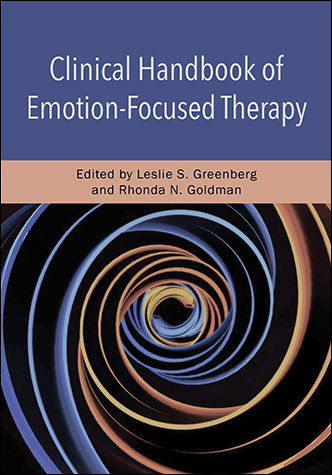
Clinical Handbook of Emotion-Focused Therapy
ISBN: 978-1-4338-2977-2Available formats
Also available from
Through emotion-focused Therapy (EFT), clients learn to rule their emotions, instead of letting their emotions rule them.
With guidance from a skilled EFT therapist to help them identify, experience, accept, and tolerate difficult emotions, people can learn to regulate, explore, make sense of, transform, and flexibly manage their emotions. As a result, they are able to respond adaptively to situations as they arise.
EFT therapists help individuals and couples engage in productive emotional processing. They also offer methods to help clients become aware of their emotional needs.
In this book, Leslie S. Greenberg and Rhonda N. Goldman have gathered experts to offer a comprehensive tour of EFT research and applications for all common mental health issues, including depression, anxiety, interpersonal trauma, personality disorders, and eating disorders.
Readers will learn to:
- conceptualize clients' core emotions in order to form a focus of therapy
- guide clients through the process of emotional change
- structure therapy in an ongoing fashion
- recognize key emotional markers
- facilitate the tasks needed to move to the next phase
Contributors
Preface
Part I: Introduction to Emotion-Focused Therapy
- Chapter 1: History and Overview of Emotion-Focused Therapy
Rhonda N. Goldman - Chapter 2: Theory of Functioning in Emotion-Focused Therapy
Leslie S. Greenberg - Chapter 3: Theory of Practice of Emotion-Focused Therapy
Leslie S. Greenberg and Rhonda N. Goldman
Part II: Integrating Research and Practice in Emotion-Focused Therapy
- Chapter 4: Clinical Implications of Research on Emotion-Focused Therapy
Ladislav Timulak, Shigeru Iwakabe, and Robert Elliott - Chapter 5: Role of the Therapeutic Relationship in Emotion-Focused Therapy
Jeanne Watson - Chapter 6: Therapeutic Presence: The Foundation for Effective Emotion-Focused Therapy
Shari M. Geller - Chapter 7: How Clients “Change Emotion With Emotion”: Sequences in Emotional Processing and Their Clinical Implications
Antonio Pascual-Leone and Ueli Kramer - Chapter 8: Relating Process to Outcome in Emotion-Focused Therapy
Alberta E. Pos and Bryan H. Choi - Chapter 9: Facilitating Optimal Emotional Processing
Imke R. Herrmann and Lars Auszra - Chapter 10: Task Analyses of Emotional Change
Jason M. Sharbanee, Rhonda N. Goldman, and Leslie S. Greenberg - Chapter 11: Narrative Change Processes and Client Treatment Outcomes in Emotion-Focused Therapy
Lynne Angus, Tali Boritz, Inês Mendes, and Miguel M. Gonçalves - Chapter 12: Emotion Coaching in Action: Experiential Teaching, Homework, and Consolidating Change
Serine H. Warwar and Jennifer Ellison
Part III: Clinical Practice of Emotion-Focused Therapy With Specific Client Populations
- Chapter 13: Emotion-Focused Therapy for Depression.
João Salgado, Carla Cunha, and Marina Monteiro - Chapter 14: Emotion-Focused Therapy for Generalized Anxiety Disorder
Jeanne Watson, Ladislav Timulak, and Leslie S. Greenberg - Chapter 15: Emotion-Focused Therapy for Social Anxiety
Robert Elliott and Ben Shahar - Chapter 16: Emotion-Focused Therapy for Complex Interpersonal Trauma
Ula Khayyat-Abuaita and Sandra Paivio - Chapter 17: Emotion-Focused Therapy for Personality Disorders
Alberta E. Pos and Danielle A. Paolone - Chapter 18: Emotion-Focused Family Therapy for Eating Disorders
Joanne Dolhanty and Adele Lafrance - Chapter 19: Integrating Feminist-Multicultural Perspectives Into Emotion-Focused Therapy
Heidi M. Levitt, William J. Whelton, and Shigeru Iwakabe
Part IV: Emotion-Focused Therapy for Couples
- Chapter 20: Emotion-Focused Therapy for Couples
Catalina Woldarsky Meneses and Jacqueline M. McKinnon - Chapter 21: Integrating Individual Tasks Into Emotion-Focused Therapy for Couples
Charles Edwards and Jamie Levin-Edwards - Chapter 22: Mastering the Interventions of Emotion-Focused Therapy for Couples
Brent Bradley
Part V: Conclusions
- Chapter 23: Enduring Themes and Future Developments in Emotion-Focused Therapy
Rhonda N. Goldman and Leslie S. Greenberg
Index
About the Editors
Leslie S. Greenberg, PhD, is Distinguished Research Professor Emeritus of Psychology at York University in Toronto.
He has authored and coauthored the major texts on emotion-focused approaches to treatment, including the original books Emotion in Psychotherapy (1986) and Emotionally Focused Therapy for Couples (1988) and, more recently, Emotion-Focused Couples Therapy: The Dynamics of Emotion, Love, and Power (2008); Emotion-Focused Therapy: Theory and Practice (2010); Case Formulation in Emotion-Focused Therapy (2015); and Emotion-Focused Therapy for Generalized Anxiety (2017).
He received the 2004 Distinguished Research Career Award of the International Society for Psychotherapy Research as well as the 2012 APA Award for Distinguished Professional Contribution to Applied Research.
He conducts a private practice and trains people in emotion-focused approaches.
Rhonda N. Goldman, PhD, is a professor and a clinical psychology faculty member at the Illinois School of Professional Psychology at Argosy University, Schaumburg, and an affiliate psychotherapist at the Family Institute at Northwestern University, where she practices emotion-focused therapy (EFT) for both individuals and couples.
Dr. Goldman received her doctoral degree in clinical psychology from York University in Toronto, Canada.
She teaches psychotherapy and conducts research on EFT for couples, emotional processes, empathy, vulnerability, depression, and self-soothing.
She is the 2011 recipient of the Carmi Harari Early Career Award from APA Division 32 (Society of Humanistic Psychology). She is past-president of the Society for the Exploration of Psychotherapy Integration and a cofounding board member of the International Society for Emotion-Focused Therapy.
Dr. Goldman travels internationally, conducting trainings and workshops in EFT for both individuals and couples.
A comprehensive tour of EFT research and applications for all common mental health issues including depression, anxiety, interpersonal trauma, personality disorders, and eating disorders.
—Midwest Book Review
By far the most comprehensive resource to date for understanding and implementing this pillar of evidence-based practice. International scholars cover EFT's conceptual and empirical foundations, as well as its interventions and treatment modalities.
—Louis G. Castonguay, PhD
Professor of Psychology, Pennsylvania State University, University Park
This impressive compilation is, without doubt, an essential resource for clinicians and researchers interested in the role that emotion plays in the therapeutic change process.
—Marvin R. Goldfried, PhD
Distinguished Professor of Psychology, Stony Brook University, Stony Brook, NY
Emotion-focused therapy is still pushing the field in areas where the mainstream lags. This book provides a summary of the four decades of work that led to the consensus that emotions are central to human experience and to successful psychotherapy.
—Steven C. Hayes, PhD
Codeveloper of Acceptance and Commitment Therapy, University of Nevada, Reno