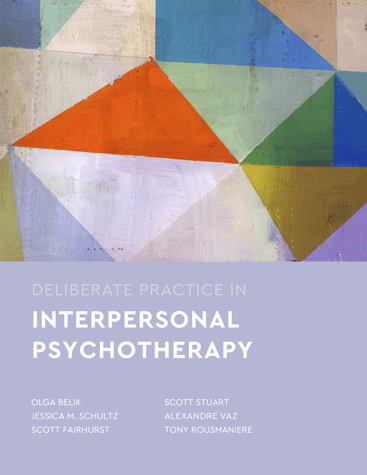
Deliberate Practice in Interpersonal Psychotherapy
ISBN: 978-1-4338-4046-3Deliberate practice exercises provide trainees and students an opportunity to build competence in essential interpersonal therapy skills while developing their own personal therapeutic style.
These exercises present role-playing scenarios in which two trainees act as a client and a clinician, switching back and forth under the guidance of a supervisor. The clinician improvises appropriate and authentic responses to client statements organized into three difficulty levels—beginner, intermediate, and advanced—that reflect common client questions and concerns.
Each of the first 10 exercises focuses on a single skill, including developing an interpersonal inventory of patients' relationships, building social skills, and helping patients connect with their own thoughts and emotions and empathize with others. Two comprehensive exercises follow in which trainees integrate these essential skills into a single session.
Step-by-step instructions guide participants through the exercises, identify criteria for mastering each skill, and explain how to monitor and adjust difficulty. Guidelines to help trainers and trainees get the most out of training are also provided.
To demonstrate how deliberate practiceopens in new window can be fully integrated into a professional curriculum, this series features exercises developed and refined within the clinical training curriculum at the Sentio online marriage and family therapy (MFT) therapist training programopens in new window in California, which is where we started developing this series. These exercises, which have been tested at clinical training sites around the world, are used to enhance clinical outcomes within the first hybrid MFT program approved by the California Board of Behavioral Sciencesopens in new window (BBS) to fully integrate deliberate practice into its entire curriculum. By integrating these models into its hybrid MFT program in California, Sentio University demonstrates that therapist training graduate programs can use deliberate practice to bridge the gap between theory and clinical mastery through repetitive, feedback-informed practice to support the development of modern, outcome-focused clinicians.
Series Preface
Tony Rousmaniere and Alexandre Vaz
Acknowledgments
Part I. Overview and Instructions
- Chapter 1. Introduction and Overview of Deliberate Practice and Interpersonal Psychotherapy
- Chapter 2. Instructions for the Interpersonal Psychotherapy Deliberate Practice Exercises
Part II. Deliberate Practice Exercises for Interpersonal Psychotherapy Skills
Exercises for Beginner Interpersonal Psychotherapy Skills
- Exercise 1. Presenting the Interpersonal Inventory: Interpersonal Inventory I
- Exercise 2. Exploring Interpersonal Relationships: Interpersonal Inventory II
- Exercise 3. Clarifications
Exercises for Intermediate Interpersonal Psychotherapy Skills
- Exercise 4. Interpersonal Framing of Distress
- Exercise 5. Helping the Client to Describe Their Distress and Need for Support
- Exercise 6. Reinforcement of Effective Communication
Exercises for Advanced Interpersonal Psychotherapy Skills
- Exercise 7. Communication Analysis
- Exercise 8. Generating Communication Options
- Exercise 9. Mobilizing Social Support
- Exercise 10. Motivating Interpersonal Action
Comprehensive Exercises
- Exercise 11. Annotated Interpersonal Psychotherapy Practice Session Transcript
- Exercise 12. Mock Interpersonal Psychotherapy Sessions
Part III. Strategies for Enhancing the Deliberate Practice Exercises
- Chapter 3. How to Get the Most Out of Deliberate Practice: Additional Guidance for Trainers and Trainees
Appendix A. Difficulty Assessments and Adjustments
Appendix B. Deliberate Practice Diary Form
Appendix C. Additional Approaches and Troubleshooting When Implementing the Interpersonal Inventory
Appendix D. Sample Interpersonal Psychotherapy Syllabus With Embedded Deliberate Practice Exercises
References
Index
About the Authors
Olga Belik, PhD, is chief psychologist and director of training at Child & Family Development Center in Providence Saint John's Health Center. She is also the national trainer and supervisor with the Interpersonal Psychotherapy Institute with a private practice in forensic psychology. She was chair of the California Psychological Association’s Division II: Training and Education in Professional Psychology. She earned an award for Distinguished Contributions to the Education and Training of Child and Adolescent Mental Health Psychologists from the American Psychological Association’s Board of Educational Affairs.
Jessica M. Schultz, PhD, is a licensed psychologist and professor of psychology at Augustana College (Rock Island, IL). She has been engaged in clinical work and research in interpersonal psychotherapy (IPT) for more than 15 years. Recognized as a fellow by the IPT Institute, her IPT training experience includes serving as a presenter, supervisor, and consultant for clinicians across the world. She coauthored the clinical guide Interpersonal Psychotherapy: Clinician’s Handbook (IPT Institute Press) and multiple articles related to IPT. In addition to her academic and training roles, Dr. Schultz maintains a small clinical practice.
Scott Fairhurst, PhD, is the vice president of Outcomes, Training, and Special Projects at Pacific Clinics, a community mental health center in Southern California. As a clinician and program director for over 25 years, his work primarily focuses on children and adolescents with explosive behavior. Dr. Fairhurst has worked with clients in hospitals, residential treatment, and clinics. He promotes value-based care and democratizing clinical data so that clients, executives, clinicians, and supervisors can measure and manage what they consider to be important. He also offers training in de-escalation of suicidal thoughts and behaviors and conflict resolution.
Scott Stuart, MD, is emeritus professor of psychiatry and psychology in the Departments of Psychiatry, Psychology, Pediatrics and Obstetrics and Gynecology at the University of Iowa. He is also director of the Interpersonal Psychotherapy Institute, an international training organization, and an adjunct professor at the University of Southern California Keck School of Medicine in Los Angeles. He has received several teaching awards, including the John Clancy Teacher of the Year Award from the University of Iowa. Dr. Stuart is also the author of the Interpersonal Psychotherapy: A Clinician’s Guide.
Alexandre Vaz, PhD, is chief academic officer of Sentio University marriage and family therapy (MFT) program in Californiaopens in new window. This innovative online/hybrid MFT programopens in new window was the first approved by the California Board of Behavioral Science for MFT licensure to fully integrate deliberate practiceopens in new window into its curriculum to ensure superior clinical outcomes. He is also director of clinical training for the Sentio Counseling Centeropens in new window which is Sentio MFT program’s guaranteed practicumopens in new window site where students provide low-cost online couples therapy in Californiaopens in new window. Dr. Vaz is the author/coeditor of many books on deliberate practice and psychotherapy training.
Tony Rousmaniere, PsyD, is president of Sentio University marriage and family therapy (MFT) program in Californiaopens in new window. He led the development of online/hybrid MFT programopens in new window, which is the first MFT therapist training program approved by the California Board of Behavioral Science for MFT licensure that fully integrates deliberate practiceopens in new window. Dr. Rousmaniere is the author/coeditor of many books on psychotherapy training. He is also the executive director of the Sentio Counseling Centeropens in new window, which is Sentio MFT program’s guaranteed practicumopens in new window site where students provide sliding-scale online therapy in Californiaopens in new window, and past president of the APA’s Division 29.
This book provides a cutting-edge approach to training a broad spectrum of providers in interpersonal psychotherapy. This is an important contribution to psychotherapy training that will be of interest to clinicians committed to providing quality, personalized, and “deliberate” clinical care. The clinical significance of this work is extraordinary.
—Gregory G. Kolden, PhD, University of Wisconsin Department of Psychiatry, Madison, WI, United States
I wish Deliberate Practice in Interpersonal Psychotherapy had been available when I was training in interpersonal psychotherapy (IPT) many years ago. The book offers exercises for the beginning--and also the experienced--psychotherapist that provide a wealth of material to improve the practice of IPT, a therapy that looks easy from the outside but is difficult to practice in the real world. This book will help greatly in getting therapists to practice IPT in an effective way.
—Marc B. J. Blom, MD, PhD, Former President, Dutch Society for Interpersonal Psychotherapy; Former Executive Board Member, Parnassia Group; and Department of Mood Disorders, PsyQ, The Hague, The Netherlands
This book provides detailed exercises with clear instructions to facilitate learning interpersonal psychotherapy for trainees at any level. Essential resources for supervisors about how and why to use each exercise are included. This is a must-have tool for interpersonal psychotherapy supervisors and learners alike.
—Shannon N. Lenze, PhD, Associate Professor of Psychiatry, Washington University School of Medicine, St. Louis, MO, United States
This volume stands out in quality from others in the field. The writing is clear, and it is an essential resource for any therapist seeking to enhance their skills in interpersonal psychotherapy. The book combines updated theoretical support with a rare and invaluable practical component: a set of exercises that facilitates clinical practice for those who want to improve every day. The volume’s exercise tools are indispensable for those engaged in psychotherapeutic intervention, offering a progression that benefits both beginners and experienced professionals alike, fostering continuous improvement. The authors’ clarity in addressing complex topics and the embedded Kaizen philosophy make this a must-read for all practitioners committed to refining their skills and better serving their patients.
—Ivandro Soares Monteiro, PhD, Clinical Psychologist and Certified Psychotherapist; Founder and Director of the Academy of Interpersonal Psychotherapy; and University Professor, School of Medicine and Biomedical Sciences, ICBAS Instituto de Ciências Biomédicas Abel Salazar, Porto, Portugal
Watch the author(s) discuss Deliberate Practice in Interpersonal Psychotherapy.opens in new window Interested in this book? Purchase a copy to continue (or start) the conversation with your clients.
This book is part of the Essentials of Deliberate Practice series by Tony Rousmaniere and Alexandre Vaz. The materials on this page include a Deliberate Practice Reaction Form and a Deliberate Practice Diary Form that can be used with every book in this series, as well as volume-specific content.
These documents are offered for your personal use in clinical training or teaching courses. If you reprint or adapt them for publication, permission is required from the publisher.
Deliberate Practice Reaction Form
The Deliberate Practice Reaction Form can be used with any of the deliberate practice exercises throughout the series to measure how challenging it was for the trainees and to adjust the difficulty as needed. Appendix A includes a black-and-white version of the form with instructions for assessing and modifying an exercise’s difficulty. A color version of the Deliberate Practice Reaction Form is also available for individual download.
- Appendix A: Difficulty Assessments and Adjustments (PDF)opens in new window
- Deliberate Practice Reaction Form (PDF)opens in new window
Deliberate Practice Diary Form
The Deliberate Practice Diary Form is an optional form that trainees can complete during a training session’s final evaluation or between sessions to process their experiences with the activity, including what was and was not helpful and what they learned. Appendix B, which is the same across all books in the series, presents this form.
Volume-specific materials
The following content is unique to Deliberate Practice in Interpersonal Psychotherapy and includes (a) a guide to implementing and troubleshooting the implementing the interpersonal inventory in Exercise 2 and (b) a sample syllabus that integrates the deliberate practice exercises into a standard clinical course.
- Appendix C: Additional Approaches and Troubleshooting When Implementing the Interpersonal Inventory (PDF)opens in new window
- Appendix D: Sample Interpersonal Psychotherapy Syllabus With Embedded Deliberate Practice Exercises (PDFopens in new window | Wordopens in new window)
Video demonstration
A YouTube series (Practice Time! with Amy DeSmidt and Jamie Manseropens in new window) highlights authentic deliberate practice sessions featuring exercises from various volumes in the Essentials of Deliberate Practice series.
Supplemental resources for therapist training
Designed for faculty at graduate institutions, these supplemental resources provide a framework and clear examples for implementing deliberate practice within existing therapist training curricula. Sentio University is where we started to develop what would become the APA Essentials of Deliberate Practice series. We provide a comprehensive suite of free psychotherapy training resources based on the deliberate practice methodologyopens in new window. These materials are designed to supplement modern hybrid and online therapist training curricula and are used extensively within our own clinical programs.
- California MFT program integration: These materials are a core component of the Sentio hybrid MFT program in Californiaopens in new window, the first in the state to fully integrate DP into its entire curriculum and receive California Board of Behavioral Sciences approval for licensure.
- Free deliberate practice exercises: Access our library of therapist skill-building worksheetsopens in new window used to enhance the online California MFT degree through repetitive, feedback-informed practice.
- Deliberate practice video demonstrations: Visit our YouTube channel for free therapist training videosopens in new window to view clinical demonstrations from the APA Essentials of Deliberate Practice book series. These videos illustrate key skills used to enhance the online California MFT degree through repetitive, feedback-informed practice.
- AI and emerging therapy resources: Learn how deliberate practice can be used to safely and ethically integrate AI for therapist trainingopens in new window. Review our AI research programopens in new window and our clinical guidelines on using AIopens in new window to prepare for the modern landscape of digital mental health.