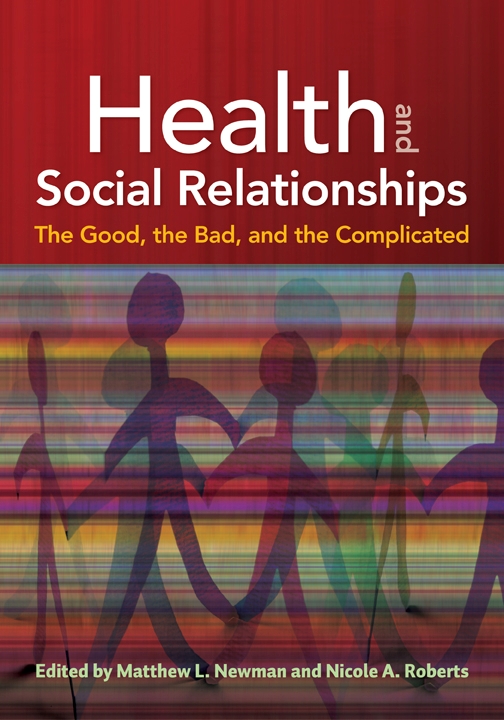
Health and Social Relationships
We know that good, supportive relationships generally promote good health, and that bad, stressful relationships take a toll on our health. Yet most of our relationships—those with relatives, coworkers, caregivers, and romantic partners among them—are complicated, providing varying degrees of both support and stress.
The contributors to Health and Social Relationships not only examine the psychological and physiological linkages between relationships and health, but also offer clinical implications—such as how to foster good social relationships in our personal lives and in our communities at large.
Health and Social Relationships is an excellent compendium of research geared toward scholars and students in health psychology at the advanced undergraduate and graduate levels.
Contributors
Acknowledgments
Introduction
Matthew L. Newman
Part I. The Big Picture
- 1. Social Relationships, Social Threat, and Health
Suman Lam and Sally S. Dickerson - 2. The Effects of Giving on Givers
Sara Konrath and Stephanie Brown
Part II. Romantic Relationships
- 3. Marriage, Affectionate Touch, and Health
Mary H. Burleson, Nicole A. Roberts, Tara M. Vincelette, and Xin Guan - 4. Romantic Separation, Loss, and Health: A Review of Moderators
Ashley E. Mason and David A. Sbarra - 5. Health Behavior and Emotion Regulation in Couples
Jane A. Skoyen, Anya V. Kogan, Sara A. Novak, and Emily A. Butler
Part III. Families, Peers, and Cultures
- 6. Family Relationships and Physical Health: Biological Processes and Mechanisms
Erin T. Tobin, Richard B. Slatcher, and Theodore F. Robles - 7. Peer Relationships and Health: From Childhood Through Adulthood
Kathleen S. Bryan, Yesmina N. Puckett, and Matthew L. Newman - 8. The Role of Cultural Fit in the Connection Between Health and Social Relationships
José A. Soto, Yulia Chentsova-Dutton, and Elizabeth A. Lee
IV. Practical Implications
- 9. Resilience: A Framework for Understanding the Dynamic Relationship Between Social Relations and Health
Anne Arewasikporn, Mary C. Davis, and Alex Zautra - 10. Relating for Health: Clinical Perspectives
Nicole A. Roberts
Index
About the Editors
Matthew L. Newman, PhD, is an assistant professor of psychology at Arizona State University (ASU) in the School of Social and Behavioral Sciences and directs the Stress and Social Relationships Laboratory there. He received his doctorate in social psychology from the University of Texas at Austin in 2003, where he also completed 2 years of postdoctoral training in behavioral neuroscience with the Texas Consortium for Behavioral Neuroscience.
Prior to joining the ASU faculty in 2007, Dr. Newman served as a visiting professor at Bard College; he has also held faculty positions at the University of Texas and Southwestern University.
Dr. Newman is widely published, and his work has appeared in such peer-reviewed professional journals as the Journal of Personality and Social Psychology, Psychological Science, the Journal of Adolescence, Personality and Social Psychology Bulletin, Hormones and Behavior, and American Psychologist.
Nicole A. Roberts, PhD, is an assistant professor of psychology at Arizona State University (ASU) in the School of Social and Behavioral Sciences and directs the Emotion, Culture, and Psychophysiology Laboratory there. She received her doctorate in clinical psychology from the University of California, Berkeley in 2003 and completed her clinical internship and postdoctoral training at the Northern California Veterans Administration Health Care System and University of California, Davis, Department of Psychiatry.
Prior to joining the ASU faculty in 2006, she held a faculty position at the University of Wisconsin, Milwaukee.
Dr. Roberts' research focuses on the study of emotion and on the cultural and biological forces that shape emotional responses, using both observational and psychophysiological measures.
Dr. Roberts is widely published, and her work has appeared in peer-reviewed professional journals such as the Journal of Marriage and Family; Family Process; the Journal of Cognitive, Affective, and Behavioral Neuroscience; Epilepsy and Behavior; Neurology; and Emotion.