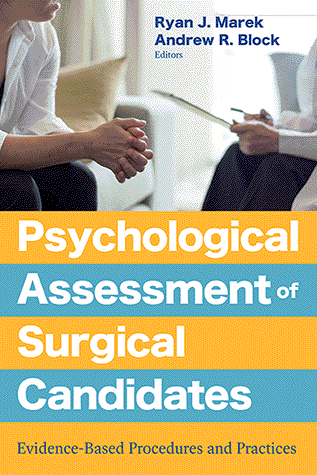
Psychological Assessment of Surgical Candidates
Available formats
Also available from
Psychosocial factors, such as caregiver support and patients’ expectations for quality of life after surgery, can have a strong impact on surgery outcomes. This book presents evidence-based approaches to presurgical psychological assessment across a broad range of medical conditions.
Psychologists and other mental health professionals are increasingly included within the preoperative evaluation process for patients preparing for major surgery. Presurgical psychological assessment (PPA) aims to assess both the risk factors for poor surgical outcome, as well as patient strengths and resources that can have a positive impact on surgery results.
This book presents evidence-based approaches to PPA across a broad range of medical conditions. Chapters outline a flexible model and practical tips for conducting PPA. They also offer selection and administration guidelines for psychological testing and clinical interviews, and information about relevant ethical and legal issues. Chapters review specific surgical areas in which PPAs are routinely conducted, including metabolic and bariatric, gynecologic, spinal procedures, gender embodiment, breast cancer treatment and prevention, solid organ transplant, deep brain stimulation, and treatment for temporal lobe epilepsy.
Introduction: Presurgical Psychological Assessments: Historical Perspectives and Current Status
Ryan J. Marek and Andrew R. Block
- Chapter 1: The Risk Identification and Mitigation (RIM) Model for Presurgical Psychological Assessments
Ryan J. Marek and Andrew R. Block - Chapter 2: Selecting and Administering Psychological Measures for Presurgical Assessments
Ryan J. Marek - Chapter 3: Ethical Considerations in the Assessment of Surgical Candidates
Christine D. Liff and Shane S. Bush - Chapter 4: Metabolic and Bariatric Surgery
Allyson Diggins and Ninoska Peterson - Chapter 5: Spine Surgery
Julie Murray, Jayme S. Warner, and Scott DeBerard - Chapter 6: Gender Embodiment Surgery
Zo Amaro Jimenez and Colt St. Amand - Chapter 7: Surgery for Treatment and Prevention of Breast Cancer
Andrea Bradford - Chapter 8: Solid Organ Transplant
Wendy Balliet, D. Brian Haver, Stacey Maurer, and Lillian Christon - Chapter 9: Deep Brain Stimulation for Parkinson’s Disease and Depression
Jennifer A. Foley - Chapter 10: Gynecologic Surgery
Andrea Bradford - Chapter 11: Surgical Treatment of Temporal Lobe Epilepsy
Genevieve Rayner, Honor Coleman, Emily Cockle, Andrew Neal, Charles Malpas - Chapter 12: Practical Suggestions for Presurgical Psychological Assessments and Future Directions for the Field
Andrew R. Block
Ryan J. Marek, PhD, is an assistant professor of clinical psychology at Sam Houston State University College of Osteopathic Medicine (SHSU-COM). Dr. Marek teaches medical students, engages in an active program of research, serves as consulting editor for both medical and psychological peer-reviewed journals, and holds a practice at SHSU Physicians clinic where he conducts various psychological assessments (including presurgical evaluations) and therapy.
Dr. Marek’s program of research is focused on understanding how psychological factors contribute to medical outcomes. He currently has over 50 peer-reviewed publications mostly focused on presurgical psychological evaluations and how they predict various outcomes.
Andrew R. Block, PhD, is a fellow of APA and is board certified in Clinical Health Psychology. He has provided presurgical psychological evaluations and chronic pain treatment for more than 40 years, the last 32 at Texas Back Institute.
He has over 50 peer-reviewed publications primarily focused on psychosocial influences on spine surgery outcome, most recently studying the MMPI-2-RF and MMPI-3. He is codeveloper, along with Yossef Ben-Porath, of the MMPI-2-RF spine surgery candidate and spinal cord stimulator candidate interpretive reports.
He has four previous books, including Presurgical Psychological Screening: Understanding Patients, Improving Outcomes.
He may be contacted by emailopens in new window.
Welcome to the resource library for Psychological Assessment of Surgical Candidates: Evidence-Based Procedures and Practices. The links below allow you to download additional resources for assessing candidates for organ transplants (the subject of Chapter 8).
The tables and figures included here summarize several key topics for behavioral health providers who work with candidates for organ transplant surgery, including understanding the patient's perspective of the experience of receiving an organ transplant; assessment considerations specific to heart, lung, kidney, and liver transplants; and common surgical and nonsurgical treatments for organ diseases. Also included is a listing of standardized psychosocial assessment interview tools.
These documents are offered for your personal use. If you reprint or adapt them for publication, permission is required from the publisher. All material is ©2023 American Psychological Association unless otherwise noted. The opinions and statements presented in these documents are the responsibility of the authors, and such opinions do not necessarily represent the opinions or policies of APA.
© 2023 American Psychological Association.
- Supplemental Figure 8.1. Stages of the Organ Transplant Process for the Patient (MS Word)opens in new window
- Supplemental Figure 8.2. Psychosocial Factors in PPA for Organ Transplant Candidates (MS Word)opens in new window
- Supplemental Table 8.1. Organ-Specific Guidelines for Assessment of Transplant Candidates (MS Word)opens in new window
- Supplemental Table 8.2. Self-Management Related to Transplant Care (MS Word)opens in new window
- Supplemental Table 8.3. Common Symptoms and Treatments in End-Stage Liver Disease (MS Word)opens in new window
- Supplemental Table 8.4. Symptoms and Interventions for Advanced Lung Disease and Heart Failure (MS Word)opens in new window
- Supplemental Table 8.5. Common Treatments and Considerations in End-Stage Kidney Disease (MS Word)opens in new window
- Supplemental Table 8.6. Selected Assessment Measures Used in PPA-TC (MS Word)opens in new window
- Supplemental Table 8.7. Alcohol-Related Risk Factors to Assess in PPA-TC for Liver Transplant Patients (MS Word)opens in new window
- Supplemental Table 8.8. Assessment Tools for Risk to Recidivism to Alcohol Post-LT (MS Word)opens in new window
- Supplemental Table 8.9. Standardized Psychosocial Assessment Interview Tools (MS Word)opens in new window