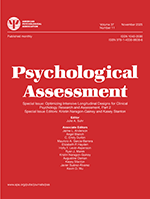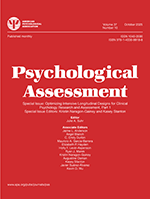

This is the second section of a two-part series on contemporary assessment practices.
The first section, published in April of this year, focused on general and diversity issues in assessment.
This second section focuses on assessment applications to specific populations, in specific settings, and using specific methods.
Guest Editor
Table of contents
View the table of contents with abstracts on APA PsycNET
- Contemporary Assessment Practices Part 2: Special Populations, Settings, and Methods
Kathi A. Borden
Specific Settings
- Questionnaire Use Among Nordic Neuropsychologists: Shift From Assessing Personality to Checking Ecological Validity of Neuropsychological Assessments?
Jens Egeland, Marianne Løvstad, Anne Norup, Taina Nybo, Bengt A. Persson, Diego Rivera, Anne-Kristine Schanke, Solrun Sigurdardottir, and Juan Carlos Arango-Lasprilla - Identifying Measurement-Based Care Practices of VHA Co-Located Collaborative Care Providers
Paul R. King, Gregory P. Beehler, Christina L. Vair, Julie Gass, Jennifer S. Funderburk, Kaitlin R. Lilienthal, and Jonathan H. Novi
Specific Clinical Problems
- Trends in Professionals' Use of Eating Disorder Assessment Instruments
Terra L. Towne, Kyle P. De Young, and Drew A. Anderson - Evidence-Based Assessment of Interpersonal Dependency
Robert F. Bornstein and Christopher J. Hopwood - Utility of a Single-Item Child Anxiety Rating for Use in Community Practice
Adam F. Sattler, Michael S. Tiede, Julie E. Dammann, Andrea Hilson Jensen, Gwendolyn A. Walton, and Stephen P. H. Whiteside
How Standard Assessment Practice is Defined
- MMPI-2, MMPI-2-RF, and MMPI-A Administrations (2007–2014): Any Evidence of a "New Standard?"
Carolyn L. Williams and Stephen J. Lally - An Update to Williams and Lally's (2017) Analysis of MMPI–2–RF Acceptance
Yossef S. Ben-Porath - Response to Article by Williams and Lally: What Is the Best Test to Use?
Linda K. Knauss - Response to Ben-Porath's Update to Williams and Lally (2017)
Stephen J. Lally and Carolyn L. Williams