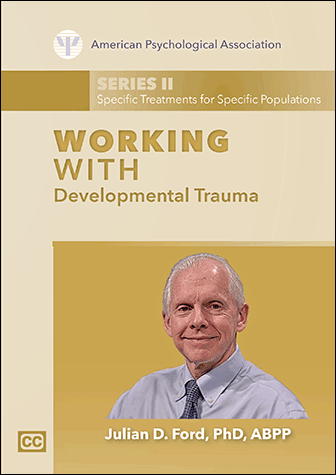
Working With Developmental Trauma
ISBN: 978-1-4338-3095-2Available formats
Streaming options
Developmental trauma is a type of trauma that occurs during periods in life when primary relational bonds and the person's sense of self are vulnerable — that is, during childhood or transitions in life. Although the original trauma occurs early in life, the effects linger and manifest well into adulthood, often unexpectedly in what seems to be unrelated aspects of a person's life: romantic relationships, workplace and career, and functional family structures, for example.
Dr. Julian Ford's approach to therapy focuses on the strengths that enable the client to be resilient when faced with developmental trauma.
In this video program, Dr. Ford works with an African American man who is still profoundly affected by developmental trauma that occurred when he was a young man serving overseas in combat.
In the demonstration, Dr. Ford integrates a transtheoretical framework to help the client understand the psychobiology of stress reactions and to affirm the strength he derives from the positive legacy of fatherhood in his life, in order to provide him with a new perspective on, and a path to recovery from, developmental trauma and PTSD.
Dr. Julian D. Ford approaches psychotherapy from a multisystemic framework centering on self-regulation problems and strengths across the biological, sensory–perceptual, affective, cognitive, conative, behavioral, relational and self-identity domains.
Dr. Ford draws on cognitive–behavioral therapy, client-centered, psychodynamic/mentalizing, existential-experiential, behavior analysis, interpersonal/relational (attachment across the lifespan), narrative, feminist, and family systems conceptual models.
Dr. Ford works with clients of both genders and a variety of racial/ethnic, cultural, socioeconomic, and gender identity backgrounds, from a position of cultural humility in which it is his responsibility as a therapist to learn and be sensitive and respectful of the history, traditions, norms, and values of each unique client or family. He is particularly focused on the strengths that have enabled each client to be resilient in the face of major psychological and life stress (including traumatic stressors) challenges.
Dr. Ford uses the TARGET (Trauma Affect Regulation: Guide for Education and Therapy) model that he developed as an integrative transtheoretical framework to help clients understand the psychobiology of stress reactions in a down-to-earth manner that is remoralizing and motivating, and as a map of adaptive capacities they can draw on to increase their authentic sense of hope and to make transformational shifts in their lives.
Julian D. Ford, PhD, is a board-certified clinical psychologist and tenured professor at the University of Connecticut School of Medicine and School of Law where he is the principal investigator and director of two treatment and services adaptation centers in the National Child Traumatic Stress Network, the Center for Trauma Recovery and Juvenile Justice and the Center for the Treatment of Developmental Trauma Disorders.
Dr. Ford is the president-elect of the International Society for Traumatic Stress Studies and has served two terms on the Society's board of directors and as the vice president and secretary. He serves as an associate editor for the Journal of Trauma and Dissociation and European Journal of Psychotraumatology and as chair of the APA Division of Trauma Psychology Presidential Task Force on Child Trauma.
Dr. Ford has published more than 250 articles and book chapters and is the author or editor of 10 books, including Posttraumatic Stress Disorder, 2nd Edition, Treating Complex Trauma: A Sequenced, Relationship-Based Approach and Treating Complex Traumatic Stress Disorders in Children and Adolescents: Scientific Foundations and Therapeutic Models.
Dr. Ford is the principal investigator for the national Developmental Trauma Disorder Field trial research study. He has developed and conducted randomized clinical trial and effectiveness studies with the Trauma Affect Regulation: Guide for Education and Therapy model for youths and adults with developmental trauma histories and complex PTSD.
- Courtois, C. A., & Ford, J. D. (Eds.). (2009; 2nd Edition 2019). Treating complex traumatic stress disorders: Scientific foundations and therapeutic models. New York: Guilford.
- Courtois, C. A., & J. D. Ford (2013). Treating complex trauma: A sequenced relationship-based approach. New York: Guilford.
- Ford, J. D. & Courtois, C. A. (Eds.). (2013). Treating complex traumatic stress disorders in children and adolescents: Scientific foundations and therapeutic models. New York: Guilford.
- Ford, J. D. (2013). Enhancing emotional regulation with complex trauma survivors. In D. Murphy & S. Joseph (Eds.), Trauma, and the therapeutic relationship (pp. 58–77). New York: Palgrave MacMillan.
- Ford, J. D. (2015). An affective cognitive neuroscience-based approach to PTSD psychotherapy: The TARGET model. Journal of Cognitive Psychotherapy, 29, 69–91.
- Ford, J. D., & Ford, J. G. (2018). Enhancing emotion regulation: The TARGET approach to therapy with traumatized young mothers. In M. Muzik & K. L. Rosenblum (Eds.), Motherhood in the face of trauma: Pathways of healing and growth (Chapter 10, pp. 151–164). Frankfurt, Germany: Springer Publishing.
- Ford, J. D., & Wortmann, J. (2013). Hijacked by your brain. Naperville, IL: Sourcebooks.
APA Videos
- Cognitive Behavioral Interventions for Posttraumatic Stress Disorder
Candice M. Monson - Complex Posttraumatic Stress Disorder
Steven N. Gold - Emotion-Focused Therapy for Trauma
Sandra C. Paivio - Narrative Processes in Emotion-Focused Therapy for Trauma
Lynne Angus and Sandra C. Paivio - Spiritually Oriented Psychotherapy for Trauma
Donald F. Walker - Working With Men Survivors of Trauma and Abuse
Laura S. Brown - Working With Women Survivors of Trauma and Abuse
Laura S. Brown
APA Books
- Building Psychological Resilience in Military Personnel: Theory and Practice
Robert R. Sinclair and Thomas W. Britt - Case Formulation in Emotion-Focused Therapy: Co-Creating Clinical Maps for Change
Rhonda N. Goldman and Leslie S. Greenberg - A Practical Guide to PTSD Treatment: Pharmacological and Psychotherapeutic Approaches
Nancy C. Bernardy and Matthew J. Friedman - Treating PTSD With Cognitive-Behavioral Therapies: Interventions That Work
Candice M. Monson and Philippe Shnaider