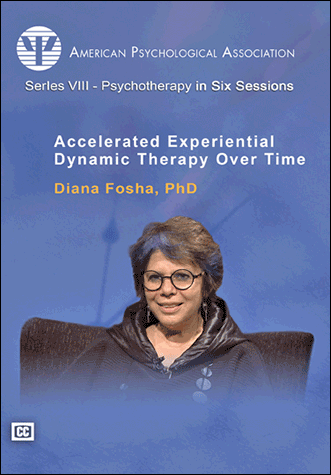
Accelerated Experiential Dynamic Psychotherapy Over Time
ISBN: 978-1-4338-3132-4Available formats
Aloneness in the face of overwhelming emotion is at the center of emotional suffering. Undoing aloneness is thus key to being able to process the emotions of trauma and reap the benefits of the adaptive resources that come with those emotions.
AEDP (accelerated experiential dynamic psychotherapy) is a healing-oriented, mind–body psychotherapy that seeks to put positive neuroplasticity into action, undo the client's aloneness, and cocreate a safe relationship as early in the therapeutic relationship as possible. Thus accompanied, and with the dyadic affect regulation of what formerly was too much to deal with, the client can process those overwhelming emotions.
Characteristic AEDP interventions include being on the lookout for glimmers of healing, undoing the client's isolation, and using metatherapeutic processing to work through the experience of transformation to systematically support the client's flourishing, resilience, and well-being.
Over the course of six therapy sessions, Dr. Diana Fosha demonstrates AEDP's intimate, moment-to-moment work with a client suffering from intense unresolved traumatic emotions. In their work together, Dr. Fosha helps the client not only experientially process negative emotions, she also uses metatherapeutic processing to systematically work with the client's positive emotions to make the most their potential.
AEDP has been described as a model of therapy that transforms emotional suffering into flourishing: We witness that in this 6-session therapy.
Accelerated experiential dynamic psychotherapy (AEDP), is a healing-oriented, mind–body treatment that works experientially with trauma and attachment trauma (Fosha, 2000; 2017, 2018; Fosha et al., 2009; Gleiser et al., 2008; Lamagna & Gleiser, 2007; Lipton & Fosha, 2011; Prenn, 2009; Prenn & Fosha, 2016; Russell, 2015; Tunnell, 2011; Yeung & Fosha, 2015).
Experientially refers to an intensive focus on present-tense (i.e., here-and-now) internal experience, especially affective experience as it arises in the body, encouraging clients' attention to it, and then proceeding to work with it. From the get-go, AEDP seeks to put positive neuroplasticity into action, moment-by moment, session to session, in each and every therapeutic dyad in the context of work to transform the negative emotions associated with trauma and emotional suffering. Then, through metatherapeutic processing, the experience of change along with the positive emotions that accompany it, are also worked with to promote positive neuroplasticity.
Integrative, nonpathologizing, and transformation-focused, AEDP is healing oriented. It assumes a healthy core within all people, emphasizes adaptive motivational strivings, works actively and explicitly to cocreate the experience of safety in the therapeutic relationship, and stresses the importance of experiential work with evolutionarily adaptive affective change processes, like emotion, attachment, and transformation.
AEDP's healing-oriented, change-based metapsychology reflects an integration of many sources: neuroplasticity research (Davidson & Schuyler, 2015; Lazar et al., 2005), affective neuroscience (Craig, 2015; Damasio, 2003; Panksepp, 2009, 2010), attachment theory and research on developmental dyads (Schore, 2012; Trevarthen, 2009); interpersonal neurobiology (Porges, 2011; Siegel, 2015), emotion theory (Darwin, 1872; Ekman, 2015); transformational studies (Buber, 1965; James, 1902; Loizzo, et al., 2017; Stern et al., 1998); as well as two decades of AEDP practice by a growing number of practitioners worldwide (Fosha, 2018a; Fishman et al., 2019).
Its theory of therapeutic change as rooted in naturally occurring change mechanisms is supported by research demonstrating the potential for neuroplasticity from the cradle to the grave (Doidge, 2007; Davidson, et al., 2003; Hanson, 2017; Lazar, et al., 2005) and documenting the nature of the conditions that bring positive neuroplasticity to the fore (e.g., Davidson & Schuyler, 2015).
AEDP understands "psychopathology" as resulting from the individual's unwilled and unwanted aloneness in the face of overwhelming emotional experiences (Fosha, 2000). Thus, undoing aloneness and the dyadic processing of emotional experiences previously too overwhelming for the individual to deal with alone, are its overarching therapeutic aims.
Through the moment-to-moment, in-depth processing of difficult emotional and relational experiences, clients are helped to recover their sense of core self and experience increased resilience and renewed zest for life (Fosha, 2009a; Russell, 2015). The metatherapeutic processing of the experience of transformation is an AEDP technique for systematically facilitating flourishing in the client (Fosha, 2009b, 2013, 2017; Fosha, Thoma, & Yeung, in press; Iwakabe & Conceicao, 2015).
Four fundamental aspects of AEDP are
- an orientation toward healing and its emphasis on healing from the get-go
- undoing aloneness
- its experiential methodology
- the moment-to-moment guiding of intervention choice by an articulated four-state transformational phenomenology
The heart and soul of AEDP is our belief in the self-righting forces wired within us all. AEDP's healing orientation is its North Star: both its theory and moment-to-moment clinical work are guided by the foundational principle that healing (i.e., positive neuroplasticity) is a biological drive, ever present in all of us that can be brought to the experiential fore in the right conditions.
We call this innate, biological drive pulsing toward self-righting and self-expansion "transformance" (Fosha, 2008). The concept of transformance is viewed not just as a generalized inner capacity or drive but as a specific emotional process arising in the therapy room. From the get-go, that is, from the very first moments of psychotherapy, finding and amplifying "glimmers of transformance" and the accompanying "vitality affects" (Stern, 1985), the positive somatic/affective markers that identify it, is a central focus within AEDP.
AEDP has elaborated a detailed, four-state phenomenology of the transformational process (Fosha, 2009a, 2009c, 2018). This four-state phenomenology reveals an arc that organically links suffering with flourishing, negative emotion with positive emotion, trauma with transcendence, stuckness with flow, and languishing with resilience (Fosha, 2005, 2013, 2017).
The goal of the work is to help the client move through the four states, tracking affective phenomena moment-to-moment to pick up subtle fluctuations and significant state shifts. The moment-to-moment guidance of clinical practice by the phenomenology of the four states of the transformational process is foundational to how AEDP therapists work.
Operating as both map and compass, it helps therapists orient where they are in the process and where they want to go, thus guiding their choice of interventions.
Diana Fosha, PhD, is the developer of AEDP (accelerated experiential dynamic psychotherapy) and founder and current director of the AEDP Institute, internationally recognized for training therapists in a healing-oriented experiential approach to the treatment of attachment trauma. For the last 20 years, she has been active in promoting a scientific basis for AEDP's healing-oriented, attachment-, emotion- and transformation-focused approach.
A leader in the field of transformational studies, Fosha's work focuses on integrating neuroplasticity, recognition science and developmental dyadic research into experiential clinical process work with patients. The author of numerous papers and book chapters, she is the author of The Transforming Power of Affect: A Model for Accelerated Change (Basic Books, 2000); senior editor, with Daniel Siegel and Marion Solomon, of The Healing Power of Emotion: Affective Neuroscience, Development & Clinical Practice (Norton, 2009), and coauthor, with Natasha Prenn, of Supervision Essentials for Accelerated Experiential Dynamic Psychotherapy (APA, 2016).
Described by psychoanalyst James Grotstein as a "prizefighter of intimacy," and by David Malan as "the Winnicott of [accelerated experiential dynamic] psychotherapy," Diana Fosha is known for her powerful, precise yet simultaneously poetic and evocative writing style. Her phrases, — "undoing aloneness," "existing in the heart and mind of the other," "True Other," "make the implicit explicit and the explicit experiential," "going beyond mirroring," "stay with it and stay with me," "rigor without shame" and "judicious self-disclosure" — capture the ethos of AEDP.
- Buber, M. (1965). The knowledge of man: Selected essays. New York: Harper Torchbooks.
- Craig, A.D. (Bud). (2015). How do you feel? An interoceptive moment with your neurobiological self. Princeton: Princeton University Press.
- Damasio, A. (2003). Looking for Spinoza: Joy, sorrow, and the feeling brain. New York: Houghton Mifflin Harcourt.
- Darwin, C.(1872/1965). The expression of emotion in man and animals. Chicago: University of Chicago Press.
- Davidson, R. J., Kabat-Zinn, J., Schumacher, J., Rosenkrantz, M., Muller, D., Santorelli, S. F., Urbanowski, F., Harrington A., Bonus. K., & Sheridan, J. F. (2003). Alterations in brain and immune function produced by mindfulness. Psychosomatic Medicine, 65(4), 564–570.
- Davidson, R. J., Schuyler, B. S. (2015). The neuroscience of happiness. World Happiness Report 2015. United Nations Sustainable Development Solutions Network. doi: https://dx.doi.org/10.14713/pcsp.v14i2.2038
- Doidge, N. (2007). The brain that changes itself: Stories of personal triumph from the frontiers of brain science. New York: Penguin Books.
- Ekman, P. (2015). Darwin and facial expressions: A century of research. Los Altos, Ca.: Malor Books.
- Fishman, D., Fosha, D., Miqdadi, D., Welling, H., & Ye-Perman (2019, June). Using qualitative clinical analysis to document the consistency of the phenomenology of transformational healing in AEDP therapy across different cultures. Presentation at the annual meeting of The Society for Exploration of Psychotherapy Integration, Lisbon, Portugal.
- Fosha D. (2009a). Emotion and recognition at work: Energy, vitality, pleasure, truth, desire & the emergent phenomenology of transformational experience. In D. Fosha, D. J. Siegel & M. F. Solomon (Eds.), The healing power of emotion: Affective neuroscience, development, clinical practice (pp. 172–203). New York: Norton.
- Fosha, D. (2000). The transforming power of affect: A model for accelerated change. New York: Basic Books.
- Fosha, D. (2008). Transformance, recognition of self by self, and effective action. In K. J. Schneider (Ed.), Existential-integrative psychotherapy: Guideposts to the core of practice (pp. 290–320). New York: Routledge.
- Fosha, D. (2009b). Positive affects and the transformation of suffering into flourishing. In W. C. Bushell, E. L. Olivo, & N. D. Theise (Eds.), Longevity, regeneration, and optimal health: Integrating Eastern and Western perspectives (pp. 252–261). New York: Annals of the New York Academy of Sciences.
- Fosha, D. (2013). Turbocharging the affects of healing and redressing the evolutionary tilt. In D. J. Siegel & Marion F. Solomon (Eds.), Healing moments in psychotherapy (pp. 129–168). New York: Norton.
- Fosha, D. (2017). How to be a transformational therapist: AEDP harnesses innate healing affects to re-wire experience and accelerate transformation. In J. Loizzo, M. Neale, & E. Wolf (Eds.), Advances in contemplative psychotherapy: Accelerating transformation (pp. 204–219). New York: Norton.
- Fosha, D. (2018). Moment-to-moment guidance of clinical interventions by AEDP's healing-oriented transformational phenomenology: Commentary on Vigoda Gonzalez's (2018) case of "Rosa." Pragmatic Case Studies in Psychotherapy, Volume 14, Module 2, Article 1, pp. 87–114. https://pcsp.libraries.rutgers.edu
- Fosha, D., Paivio, S. C., Gleiser, K. & Ford, J. (2009). Experiential and emotion-focused therapy. In C. Courtois & J. D. Ford (Eds.), Complex traumatic stress disorders: An evidence-based clinician's guide (pp. 286–311). New York: Guilford Press.
- Gleiser, K., Ford, J. D., & Fosha, D. (2008). Exposure and experiential therapies for complex posttraumatic stress disorder. Psychotherapy: Theory, Research, Practice, Training, 45(3), 340–360
- Hanson, R. (2017). Positive neuroplasticity: The neuroscience of mindfulness. In J. Loizzo, M. Neale & E. Wolf (Eds.), Advances in contemplative psychotherapy: Accelerating transformation (pp. 48–60). New York: Norton.
- Iwakabe, S., & Conceição, N. (2015). Metatherapeutic processing as a change-based therapeutic immediacy task: Building an initial process model using a task-analytic research strategy. Journal of Psychotherapy Integration, 26(3), 230–247.
- James, W. (1902). The varieties of religious experience: A study in human nature. New York: Penguin Classics.
- Kabat-Zinn, J. (2005). Full catastrophe living: Using the wisdom of your body and mind to face stress, pain and illness. New York: Bantam Dell.
- Lamagna, J., & Gleiser, K. (2007). Building a secure internal attachment: An intra-relational approach to ego strengthening and emotional processing with chronically traumatized clients. Journal of Trauma and Dissociation, 8(1), 25–52.
- Lazar, S. W., Kerr, C. E., Wasserman, R. H., Gray, J. R., Greve, D. N., Treatway, T., McGarvey, M., Quinn, B. T., Dusek, J. A., Benson, H., Rauch, S. L., Moore, C. J., & Fischi, B. (2005). Meditation experience is associated with increased cortical thickness. NeuroReport, 16(17), 1893–1897.
- Lipton, B., & Fosha, D. (2011). Attachment as a transformative process in AEDP: Operationalizing the intersection of attachment theory and affective neuroscience. Journal of Psychotherapy Integration, 21(3), 253–279.
- Loizzo, J., Neale, M., & Wolf. E. (Eds.).(2017). Advances in contemplative psychotherapy: Accelerating transformation. New York: Norton.
- Panksepp, J. (2009). Brain emotional systems and qualities of mental life: From animal models of affect to implications for psychotherapeutics. In D. Fosha, D. J. Siegel, & M. F. Solomon, (Eds.), The healing power of emotion: Affective neuroscience, development & clinical practice (pp. 1–26). New York: Norton.
- Panksepp, J. (2010). Affective neuroscience of the emotional BrainMind: Evolutionary perspectives and implications for understanding depression. Dialogues in Clinical Neuroscience, 12 (4), 533–545.
- Porges, S. W. (2011). The polyvagal theory: Neurophysiological foundation of emotions, attachment, communication, self-regulation. New York: Norton
- Prenn, N. (2009). I second that emotion! On self-disclosure and its metaprocessing. In A. Bloomgarden & R. B. Menutti, (Eds.), Psychotherapist revealed: Therapists speak about self-disclosure in psychotherapy (pp. 85–99). New York: Routledge.
- Prenn, N., & Fosha, D. (2016). Supervision essentials for accelerated experiential dynamic psychotherapy. Washington, DC: American Psychological Association.
- Russell, E. M. (2015). Restoring resilience: Discovering your clients' capacity for healing. New York: Norton.
- Ryan, R. M., & Frederick, C. M. (1997). On energy, personality and health: Subjective vitality as a dynamic reflection of well-being. Journal of Personality, 65, 529–565
- Schore, A. (2012). The science of the art of psychotherapy. New York: Norton.
- Siegel, D. J. (2015). The developing mind, Second edition: How relationships and the brain interact to shape who we are. New York: Guilford.
- Stern, D. N. (1985/2000). The interpersonal world of the infant: A view from psychoanalysis and development psychology. (Paperback Second Edition, with new Introduction, 2000). Basic Books, New York.
- Stern, D. N., Brunschweiler-Stern, N., Harrison, A. M., Lyons-Ruth, K., Morgan, A. C., Nahum, J. P., Sander L. W., Tronick, E. Z. (1998) The process of therapeutic change involving implicit knowledge: Implications of developmental observations for adult psychotherapy. Infant Mental Health Journal, 19(3), 300–308.
- Trevarthen, C. (2009). The functions of emotion in infancy: The regulation and communication of rhythm, sympathy, and meaning in human development. In D. Fosha, D. J. Siegel, & M. F. Solomon (Eds.), The healing power of emotion: Affective neuroscience, development, and clinical practice (pp. 55–85). New York: Norton.
- Tunnell, G. (2011). An attachment perspective on the first interview. In C. Silverstein (Ed.), The initial psychotherapy interview: A gay man seeks treatment. New York: Elsevier Insight Books.
- Yeung, D., & Fosha, D. (2015). Accelerated experiential dynamic psychotherapy. In The Sage Encyclopedia of Theory in Counseling and Psychotherapy. New York: Sage Publications.
APA Videos
- Accelerated Experiential Dynamic Psychotherapy (AEDP) With a Male Client
Diana Fosha - Accelerated Experiential Dynamic Psychotherapy
Diana Fosha - Brief Dynamic Therapy Over Time
Hanna Levenson - Emotion-Focused Therapy for Depression
Leslie S. Greenberg - Emotion-Focused Therapy Over Time
Leslie S. Greenberg - Existential–Humanistic Therapy Over Time
Kirk J. Schneider - Short-Term Dynamic Psychotherapy
Donald K. Freedheim - Time-Limited Dynamic Psychotherapy
Hanna Levenson
APA Books
- Emotion-Focused Therapy for Depression
Leslie S. Greenberg and Jeanne C. Watson - Existential–Humanistic Therapy, Second Edition
Kirk J. Schneider and Orah T. Krug - Learning Emotion-Focused Therapy: The Process-Experiential Approach to Change
Robert Elliott, Jeanne C. Watson, Rhonda N. Goldman, and Leslie S. Greenberg - Supervision Essentials for Accelerated Experiential Dynamic Psychotherapy
Natasha C. N. Prenn and Diana Fosha - Transformation in Psychotherapy: Corrective Experiences Across Cognitive Behavioral, Humanistic, and Psychodynamic Approaches
Edited by Louis G. Castonguay and Clara E. Hill - Working With Narrative in Emotion-Focused Therapy: Changing Stories, Healing Lives
Lynne E. Angus and Leslie S. Greenberg