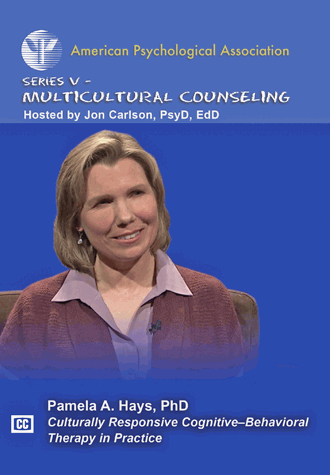
Culturally Responsive Cognitive–Behavioral Therapy in Practice
ISBN: 978-1-4338-1180-7Available formats
Streaming options
In Culturally Responsive Cognitive–Behavioral Therapy in Practice, Pamela A. Hays demonstrates her change-oriented approach to psychotherapy, adapting mainstream cognitive–behavior therapy (CBT) to fit the client's cultural identity, context, and preferences.
Key aspects of culturally responsive CBT include acceptance of core cultural beliefs, an emphasis on culturally related strengths and supports, and validation of the client's experiences of oppression with consideration of the need for environmental change. The culturally responsive thought-change process involves reconsideration of the helpfulness of thoughts rather than their rationality or validity. Culturally congruent homework is developed in close collaboration with the client.
Using everyday, culturally relevant language to describe and explain CBT, Dr. Hays works with a young African American Christian woman to recognize the client's culture as a potent source of strength and motivation.
Culturally responsive cognitive behavior therapy (CBT) begins long before the start of one's therapeutic work with clients. It begins with a commitment to the lifelong learning involved in recognizing and changing one's own knowledge gaps and biases regarding diverse groups.
Pamela Hays uses the ADDRESSING framework to conceptualize and remind therapists of these influences, which include Age and generational influences, Developmental disabilities and other Disabilities, Religion and spiritual orientation, Ethnic and racial identity, Socioeconomic status, Sexual orientation, Indigenous heritage, National origin, and Gender. Although this framework is not explicitly stated to clients, it informs the therapist's work by calling attention to possible influences on the client, the therapist, and the therapeutic relationship.
The practice of culturally responsive CBT is distinguished from mainstream CBT by the following 10 characteristics:
- the therapist's use of culturally respectful behaviors to build the therapeutic relationship;
- empowerment of the client with an emphasis on culturally related strengths and supports, for example, religious or cultural identity;
- consideration of the influence of culture on the client's environment, emotional expression, thoughts/beliefs, physical sensations/symptoms, and behavior;
- validation of the client's experiences of oppression;
- recognition of and, whenever possible, action to change oppressive (e.g. racist, sexist, heterosexist) environments before trying to change a person's thoughts about the situation;
- the use of everyday, culturally relevant language to describe and explain CBT;
- questioning the helpfulness of thoughts rather than their rationality or validity (because the latter are culture-dependent);
- caution regarding the downward arrow technique (e.g. What is the worst that could happen?) because in some contexts such as poverty environments, the worst is truly terrible (death, imprisonment, etc.);
- acceptance of core cultural beliefs (rather than challenging them);
- culturally congruent homework developed in collaboration with the client to assess progress throughout therapy.
Problems are conceptualized in two main categories. The first category consists of those for which the stress can be decreased by taking some action, summarized as the CLASS actions:
- Changing something in one's environment that directly changes the problem;
- Learning new information, a skill or hobby that helps or distracts one from the problem;
- Assertiveness, conflict resolution and other communication skills that decrease relationship stress;
- Social support; and
- Self-care activities (emotional, physical and spiritual).
The second category of problems consists of those for which the stress comes from inside the person. For this type of stress, the therapist helps the client change unhelpful thoughts to more helpful and empowering ones. The thought-change process is a collaborative one in which the therapist helps the client move away from rigid, judgmental self talk to a more compassionate internal voice. Weekly homework assignments enable the therapist and client to assess how well therapy is working.
Pamela Hays holds a PhD in clinical psychology from the University of Hawaii, a BA in psychology from New Mexico State University, and a certificate in French from La Sorbonne in Paris, France.
From 1987 through 1988, she served as a National Institute of Mental Health postdoctoral fellow at the University of Rochester's School of Medicine in Rochester, New York. From 1989 through 2000, she worked as core faculty member of the graduate psychology program at Antioch University in Seattle, Washington. Since 2000, she has worked in community mental health and private practice in rural Alaska.
Her research has included work with Tunisian women in North Africa, and Vietnamese, Lao, and Cambodian people in the United States.
She is coeditor with Gayle Iwamasa of the book Culturally Responsive Cognitive–Behavioral Therapy: Assessment, Practice, and Supervision (2006); author of the second edition of Addressing Cultural Complexities in Practice: Assessment, Diagnosis, and Therapy (2008); and author of Connecting Across Cultures: The Helper's Toolkit (in press).
She is a licensed psychologist who currently works in private practice in Soldotna, Alaska, and part-time as a supervisor for the Kenaitze Tribe. She continues as adjunct at Antioch University and teaches workshops internationally.
- Chen, S. W. H., & Davenport, D. S. (2005). Cognitive–behavioral therapy with Chinese-American clients: Cautions and modifications. Psychotherapy: Theory, Research, Practice, Training, 42, 101–110.
- Cognitive & Behavioral Practice, Special Series: Culturally responsive cognitive and behavioral practice with Latino families, 17, 154–202.
- Hays, P. A. (in press). Connecting across cultures: The helper's toolkit. Thousand Oaks, CA: Sage.
- Hays, P. A. (2009). Integrating evidence-based practice, cognitive–behavior therapy, and multicultural therapy: Ten steps for culturally competent practice. Professional Psychology: Research & Practice, 40, 354–360.
- Hays, P. A. (2008). Addressing cultural complexities in practice: Assessment, diagnosis, & therapy (2nd ed.). Washington, DC: American Psychological Association.
- Hays, P. A., & Iwamasa, G. Y. (Eds.). (2006). Culturally responsive cognitive–behavioral therapy: Assessment, practice, and supervision. Washington, DC: American Psychological Association.
- Horrell, S. C. V. (2008). Effectiveness of cognitive–behavioral therapy with adult ethnic minority clients: A review. Professional Psychology: Research and Practice, 2, 160–168.
- Jackson, L. C., Schmutzer, P. A., Wenzel, A., & Tyler, J. D. (2006). Applicability of cognitive–behavior therapy with American Indian individuals. Psychotherapy: Theory, Research, Practice, Training, 43, 506–517.
- LaFromboise, T. D., & Rowe, W. (1983). Skills training for bicultural competence: Rationale and application. Journal of Counseling Psychology, 30, 589–595.
- Martell, C. R., Safren, S. S., & Prince, S. E. (2004). Cognitive behavior therapies with lesbian, gay, and bisexual clients. New York, NY: Guilford Press.
- Payne, R. (2005). A framework for understanding poverty. Highlands, TX: aha! Process, Inc.
- Roberts, M. C., & Gallardo, M. E. (Eds.). (2009). Special section: Evidence-based practice and multicultural populations. Professional Psychology: Research & Practice, 40, 354–384.
- Wood, P. S., & Mallinckrodt, B. (1990). Culturally sensitive assertiveness training for ethnic minority clients. Professional Psychology: Research and Practice, 21, 5–11.
APA Videos
- Cognitive–Behavioral Therapy for Clients With Multiple Problems
Gayle Y. Iwamasa - Cognitive–Behavioral Therapy Strategies
Keith S. Dobson - Culturally Oriented Career Counseling
Nadya A. Fouad - Culture-Centered Counseling
Paul B. Pedersen - Ethnocultural Psychotherapy
Lillian Comas-Diaz - Inclusive Cultural Empathy in Practice
Paul B. Pedersen and Jon Carlson - Multicultural Care in Practice
Lillian Comas-Díaz - Rational Emotive Behavior Therapy
Debbie Joffe Ellis - Working With Clients With Physical Disabilities
Linda R. Mona
APA Books
- 110 Experiences for Multicultural Learning
Paul B. Pedersen - Acculturation: Advances in Theory, Measurement, and Applied Research
Edited by Kevin M. Chun, Pamela Balls Organista, and Gerardo Marin - Addressing Cultural Complexities in Practice, Second Edition: Assessment, Diagnosis, and Therapy
Pamela A. Hays - Cultural Adaptations: Tools for Evidence-Based Practice With Diverse Populations
Edited by Guillermo Bernal and Melanie M. Domenech Rodríguez - Multicultural Care: A Clinician's Guide to Cultural Competence
Lillian Comas-Diaz