Choosing the core topics to cover
The APA’s National Standards for High School Psychology Curricula (PDF, 1MB)opens in new window provide a strong infrastructure for organizing a course. The National Standards are designed to help teachers develop an accurate, comprehensive, and developmentally appropriate introductory psychology course for students in grades 9–12.
APA first commissioned a task force to develop curriculum standards in 1994. Task force members included experienced psychology educators at the secondary and university levels. These standards were approved by APA’s Council of Representatives in 1999, and they are rigorously reviewed and revised on a regular schedule not to exceed 10 years. The first revision of these psychology standards was published in 2005, and a second revision was published in 2011. This third and most current version of the standards reflects the evolving body of psychological knowledge.
The National Standards are organized into four levels:
- Five thematic pillars represent overarching areas that encompass broad areas of psychological methodology, knowledge, and study. At the foundation of these pillars, cutting across all content, is scientific inquiry and research methods.
- Within each pillar are standard areas, or unit topics that represent closely related theories and findings regarding more specific areas of knowledge and study.
-
Content standards
are specific topics teachers can use as starting points to build lessons.
- Within each content standards are specific student learning targets or objectives.
Those teaching on-level psychology courses or who are not able to cover all units of the course due to time constraints should note that the standards recommend 10 units of study that should be considered a priority for instruction. These recommended priority units are: scientific inquiry and research methods; biological bases of behavior; cognition; memory; life span development; learning; social; multiculturalism and gender; disorders; and health. The standards recommend that instruction on scientific inquiry and research methods should be included in all units of study.
Because high school psychology is a survey course covering a broad range of topics in psychology, it can sometimes seem that each topic in a unit or book chapter is distinct. However, there are common themes in psychology that cut across content areas. To demonstrate these overarching ideas and concepts that connect psychological content together, the National Standards include seven Integrative Themes (PDF, 43KB)opens in new window that teachers are encouraged to emphasize throughout the course. These themes align with the APA’s student learning outcomes for the Introductory Psychology course taught at the college level. Thus, highlighting them in the high school psychology course is a way to help students prepare for college coursework.
Integrative themes from the National Standards
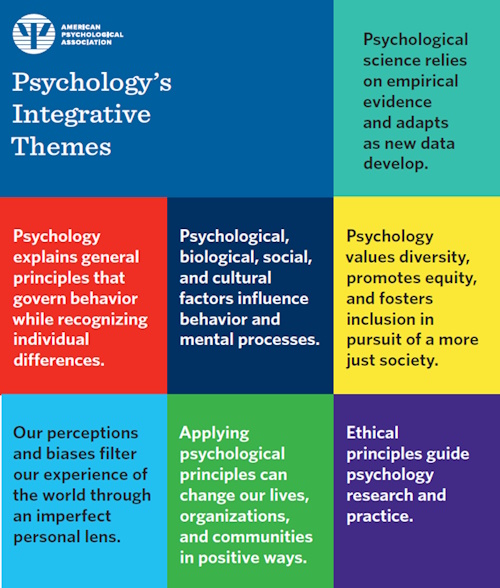 View a full-size version with detailed description of the integrative themes from the National Standards
Human diversity
Psychology aims to understand human behavior in all its complexity. An essential component of self-identity and self-image is one’s cultural identity, which includes many components such as our age, racialized identity, ethnicity, nation of origin, migration status, ability, gender identity, sexual orientation, social class, and religion/spirituality. For that reason, best practices in the teaching of psychology include instruction in cultural diversity.
TOPSS provides resources designed to broaden diversity and representation in the high school curriculum, which include research study summaries, psychologist profiles, and other resources that highlight human diversity. TOPSS has also produced a lesson plan on gender identity (PDF, 345KB)opens in new window.
However, the TOPSS Committee and APA are also aware of the fact that across the U.S., there has been legislation limiting the topics that can be taught in individual states and that parents, school boards, and other stakeholders may review and/or censure content that can be taught in high school.
APA and TOPSS provide teachers with the resources needed to teach a high school psychology course that reflects the current psychological science and adequately prepares students for college coursework. This information may be useful for teacher background even if it is not used in the classroom. Teachers are encouraged to consult with school administrators to better understand any local, state, or regional restrictions on content.
APA’s Inclusive Language Guide
can be a helpful resource for teachers and students who are interested in learning culturally sensitive terms and phrases that center the voices and perspectives of those who have been historically marginalized or stereotyped.
Ethical challenges in teaching psychology
Teachers of high school psychology sometimes face ethical challenges that are unique to this discipline. For example, students sometimes self-disclose mental health challenges or mistakenly assume the course will provide them with mental health treatment. While having an experienced mentor teacher to consult in such situations is ideal, it can also be helpful to review the APA Ethical Principles and Code of Conduct for guidance. The article “Do’s and Don’ts in Teaching Psychology” also is a helpful resource for avoiding ethical missteps.
Finding activities to deepen student learning
As in all high-quality teaching, the use of backward course design to develop a high school psychology course involves choosing instructional methods and including learning activities that will efficiently and effectively help students achieve desired learning outcomes.
There are countless sources of activities for psychology courses that teachers can find in textbooks, online, and through professional development programming. The biggest challenge that most teachers face is considering: “When should I include an activity, and what should be my criteria for choosing which activity to use?” These questions can be particularly challenging for new teachers trying to discern which activities are informed by psychological science and which reflect ideas (and sometimes myths) that have been promoted through pop psychology. We highly recommend teachers thoughtfully consider the questions in the Resource Vetting Rubric for High School Psychology Teachers (PDF, 80KB)opens in new window when selecting activities.
One heuristic that can be applied in choosing an activity is to try to determine how useful the activity is for enhancing learning, particularly of hard-to-grasp concepts or the most important concepts in a unit. A question teachers may ask is: “Will spending 45 minutes (or an hour) on this activity be the best use of time to get this concept across?” The authors of this resource have used activities that took an entire class block to set up, run, and clean up, while only reinforcing a simple concept that could have been mastered in 10–15 minutes of reading, lecture, and/or class discussion. (Jennifer Gonzalez, host of the podcast
Cult of Pedagogyopens in new window
captures this challenge in her episode, Is Your Lesson a Grecian Urn?opens in new window).
However, the authors of this resource have also devoted several full blocks to hands-on activities that effectively convey complicated information to students in ways that promoted a deep and detailed understanding seldom achieved through reaching, lecturing, and/or discussion.
Activity resources
-
Resources
that are searchable by the content pillars of the National Standards for High School Psychology Curricula have been collected from published APA teaching resources, online activities from the TOPSS unit lesson plans, and the Society for the Teaching of Psychology (STP; APA Div. 2) e-book
Promoting Psychological Science: A Compendium of Laboratory Exercises for Teachers of High School Psychology
opens in new window
. This page also includes a link to
resources designed to broaden diversity and representation in the high school curriculum
, which includes research study summaries, psychologist profiles, and other resources that highlight human diversity.
- APA’s Project Assessmentopens in new window (PASS) is a collaboratively developed digital library of free learning assessments (e.g., assignments, quizzes, evaluations) designed to help psychology educators demonstrate evidence of teaching and learning effectiveness. Users can search for, download, reproduce, and use the assessments in their classes at no cost.
- A collection of teaching resources including activities, videos, and assessments developed by a working group at the 2017 APA Summit on High School Psychology Education can be accessed through Canvas Commons.
- Teachers might also enjoy sharing engaging and accessible psychological science with students via APA’s podcast Speaking of Psychology. Speaking of Psychology features some of the field’s leading researchers discussing engaging topics that are highly relevant to our daily lives. A new episode is released every Wednesday. All episodes are available on the podcast website (with transcripts) and on Apple Podcasts, Spotify, or wherever you listen to your favorite podcasts.
- The Nicholas and Dorothy Cummings Center for the History of Psychologyopens in new window (CCHP), located on the campus of The University of Akron in Akron, Ohio, provides access to historical records and artifacts related to psychology and the study of human behavior. Some exhibits are accessible online.
Research resources
The National Standards emphasize the importance of infusing research throughout the high school psychology course as a way of emphasizing the essential role that science plays in the study of human behavior. The resources below help teachers achieve this goal.
Pacing
For your convenience, the TOPSS Committee has compiled some sample pacing calendars from high school psychology teachers for new teachers to review and adapt if helpful. APA does not endorse these calendars, but they are being provided here as examples for teachers to view and consider. The committee strives to continuously update the samples shared on this page.