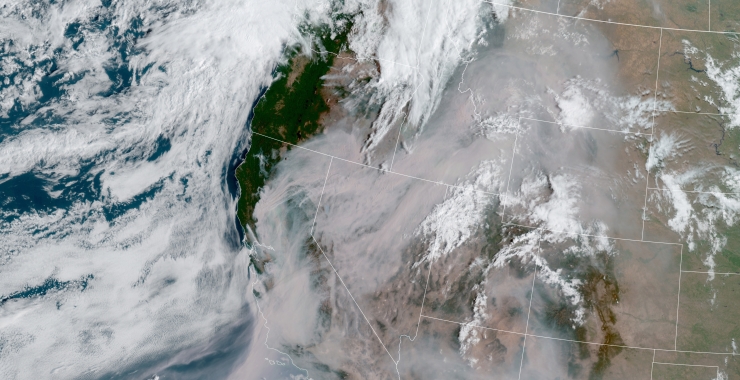
Climate change has led to longer more intense fire seasons. In this 2020 satellite photo, smoke from wildfires covers the western U.S. (From: NASA Earth Observatory / Lauren Dauphin / Data from NASA's GEOS-5 and NOAA's GOES-17 satellite)
O'Hara, D. (2021, March 5). Lessons from COVID-19 for the climate crisis. https://www.apa.org/members/content/climate-crisis-covid-19
For psychologists who study attitudes and decision-making, COVID-19 has presented a stark but fascinating opportunity to see how humans collectively handle a global crisis. What have we learned in 2020 that might help us respond effectively, and soon, to a warming climate?
“Rapid and radical action is possible,” says Elke Weberopens in new window, a psychologist and professor at Princeton University in Princeton, New Jersey, and a member of the APA's 2009 Task Force on the Interface Between Psychology and Global Climate Change. The pandemic showed that many governments around the world have been willing to accept “huge economic costs for noneconomic objectives.”
Weber, director and founder of the Behavioral Science for Policy Lab at Princeton, has focused on climate science for years. She proposed the influential concept of “the finite pool of worry,” (PDF, 1MB)opens in new window which holds that people can concentrate on only one big concern at a time. But Weber says she has seen no evidence of that finite pool of worry in two large studies she did this year.
“Quite the oppositeopens in new window,” Weber says. “Greater concern about COVID-19 is associated with greater concern about climate change and other hazards.”
However, she has observed a “finite pool of attention,” with media outlets and social media consumed with news of COVID-19.
That may change soon, though. In his inaugural address, President Joe Biden said, “we face a climate in crisis.” He is committing to a “clean energy revolution”opens in new window from the outset of his administration and has assembled a deep bench of appointeesopens in new window with experience in climate science and environmental advocacy to carry out his environmental agenda. Gina McCarthy, a former EPA administrator, will serve as Biden's national climate advisor.
With the country poised to officially accept and implement climate science, some influential research indicates that most of the American people are already there.
Jon Krosnickopens in new window, a professor at Stanford University in Palo Alto, California, concurs with Weber that urgency has continued to build around the topic of climate change, even into this extraordinary year. Krosnick, a social psychologist who studies attitude formation, is director of the Political Psychology Research Groupopens in new window, which has surveyed Americansopens in new window since 1997 on their attitudes on climate change.
The latest studyopens in new window, last summer, showed that even while people are worried about COVID-19's effects on both public health and the economy, most Americans are holding steadyopens in new window in their concern about the climate, becoming if anything more passionate about intervening to reverse ongoing environmental damage.
Belief in climate science is solid
In that very first survey in 1997, 77% said they believe the earth is probably warming, 81% said they believe that human action is responsible to some extent for that, and 85% said that this is a serious problem for the planet. Those figures last summer were 81%, 82% and 82%, respectively.
“It's amazing how stable it's been over time,” Krosnick says.
Not only that, he says, but he isn't finding a big group of climate science deniers these days. “Americans' thinking about climate science is so far ahead of their thinking on COVID-19,” Krosnick says, adding that that's to be expected: There's a solid scholarly consensus on climate science, the discussions have been going on for decades, and people can see for themselves the effects of global warming in wildfires on the West Coast, rising water levels, dramatic weather events and record-breaking heat, he notes.
In contrast, Americans have had less than a year to form ideas about COVID-19. “It's a new issue for the country,” he says. With a vaccine rolling out, “hopefully it will become a non-issue.”
Krosnick says he’s puzzled as to why any politicians still take a stance opposed to environmental action, given that the climate crisis has one of the most dedicated “issue publics” of any topic — those people who give money, go to rallies and write letters to their representatives. About 25% of Americans are members of the climate crisis issue public, compared with about 17% of Americans who are active on both sides of gun control.
“And on just about every other issue, those [issue publics] split about 50–50. Climate change is the one big exception. About 90% of the issue public on that topic is on the green side,” Krosnick says.
Krosnick agrees with Weber that COVID-19 responses have created a blueprint for addressing the climate crisis, that the fact that “we locked down the world in order to the fight the virus, that people were willing to make those sacrifices” could very well create the needed momentum.
Build and keep trust
However, 2020 has also seen the normalization of troubling behaviors that could derail action based on climate science. Experts, government on all levels, and traditional media have been “systematically attacked by the Trump administration. That does not bode well,” Weber says. Trust in both expertise and science, is “so much easier to destroy than to rebuild.”
Ordinary citizens don’t always grasp the slow, relentless processes that are contributing to climate change, just as many have been blindsided by the often exponential spread of COVID-19. Weber worries that the “wishful thinking” and conspiracy theories that warped the country's response to the pandemic are not going away, and that they could be ruinous to formulating and implementing “rational, science-based policy.”
Gale Sinatra is a professor at the University of Southern California (USC) in Los Angeles and chair of the new APA Climate Change Task Force, established in 2020. Sinatra is an expert on the psychology behind how people interact with difficult scientific information. She says education is key.
“We have to help people process information,” Sinatra says.
Much of her research is on the public understanding of science. She is the co-author, along with Barbara Hofer, a professor emerita of psychology at Middlebury College, of a forthcoming book on science denial, which Sinatra says will explain the psychology behind the challenges of public understanding of science, and will offer solutions for citizens, policymakers, journalists, and other practitioners.
Sinatra, who heads the Motivated Change Research Labopens in new window at USC, is one of 22 authors of the comprehensive “Debunking Handbook 2020opens in new window.” She differentiates “misinformation,” wrong information unwittingly disseminated, from “disinformation,” inaccuracies “pushed out” deliberately by groups who for reasons of their own want to mislead the public. With COVID-19, Americans heard from a number of sources that masksopens in new window would not lower their chances of catching the disease, and could even be harmfulopens in new window. “To the receiver, whether it's disinformation or misinformation, the outcome is the same,” she says.
Identity groups are a major influence
Many people assess information and make decisions as part of groups, Sinatra notes. People have taken cues on whether to wear masks and practice social distancing during the pandemic from leaders of the political parties they identify with. Religious and social groups can also have tremendous influence, she says.
“Identity is huge, really impactful in how people view these issues. You want to do what your in-group is doing, and that can be any group you belong to that’s important to you,” she says.
However, while trust in climate science is associated more with liberals than conservatives, attitudes on climate change are less predictable, Sinatra says. She notes, for example, that “some farmers are quite aware” of the threat of a warming planet to their livelihoodopens in new window, and they are beginning to adoptopens in new window more ecologically sustainable practices.
And some young evangelical Christians are organizingopens in new window to make climate action part of their religious life, choosing stewardship of natureopens in new window over mastery, Sinatra says.
Some of the inaccurate messaging on climate change says that human action has little effect on the environment, that there's no consensus on the science, that the whole issue is overblown. Others say it's too late for effective action, that the damage is done, or will be too costly to address, or that anything we try to do in the United States will be too localized to make a difference.
“But that's not true,” Sinatra says. “We can change our practices now and have an impact on the future, even though some changes are baked in at this point. We can mitigate the severity of climate change.”
She especially warns against putting out “doomsday messages” on the environment, because they decrease public engagement, create anxiety in the culture, are inaccurate, “and they're depressing,” Sinatra says. “Send positive messages. We saw with COVID, in the spring, when we did take strong action, it slowed the spread” of the virus for a while. When people got weary of making sacrifices, cases spiked again.
“How we think affects our behavior,” Sinatra says. “One of the lessons of the pandemic is that people will do the right thing when they are given the right information.”
APA Climate Change Coverage
- Is climate grief something new?
- APA reaffirms psychologists' role in combating climate change
- Survey: Majority of U.S. adults believe climate change is most important Issue today
- From APA's CEO: A global effort on climate change
From the Monitor on Psychology
- Addressing climate change concerns in practice
- Could COVID-19 change our environmental behaviors?
- Psychologists are working with the UN, policymakers, corporations and community groups to combat climate change
- Psychologists are working to address the defining issue of our era
- Researchers are taking stock of the emotional toll of climate change in threatened communities
- Psychologists helping cities and corporations embrace more eco-friendly behaviors