Ms. Kuts described being jolted from sleep in her 19th-floor apartment, and then her room filling with smoke.
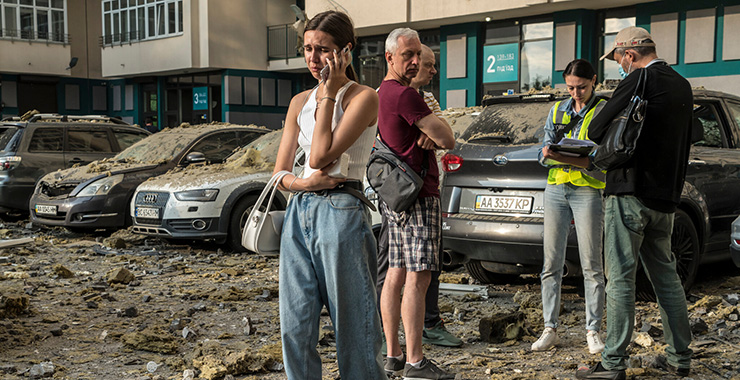
A woman searching for her son, who lived in the building in Kyiv that was hit by a missile on June 24, talked with emergency responders.
Liubov Kirnos in June in Kyiv. “When the war started, we were on duty all the time, we didn’t leave the city,” she said.
“We were just hugging, thinking we would suffocate,” she said. They eventually made their way down the stairs, helped by police officers, but were surveying the ruins of their apartment building in a stupor.
“We provide psychological first aid to people with anxiety, stress, crying, aggression,” Ms. Davydenko explained. “Then we work with people who stay on the benches, in the yard, because it’s like a second emotional wave is hitting.”
A young woman in a white tank top who had been wandering the parking lot sobbing was led over. The woman’s father, a resident, had survived the strike but was refusing to come out.
“Don’t worry, everything will be fine,” Ms. Davydenko told her, holding her arm, adding that firefighters would help her father out. “But you cannot go in—no one can.”
She waited until the father finally emerged, and the young woman threw her arms around his neck, weeping.
[Related: Talking to kids about the war in Ukraine]
Not everyone would have such a happy reunion. Later in the day, Ms. Davydenko accompanied the mother and her husband, who had been looking for their son, to examine the badly mutilated remains of a body. They were still awaiting official DNA confirmation, but the remains were most likely her son’s, the psychologist explained.
The next day, city officials confirmed that five people had been killed in the strike.
Public health experts like Dr. Jarno Habicht, the head of the World Health Organization’s office in Ukraine, have warned of the war’s long-term and widespread effects on mental health. In an interview, he said that an estimated 10 million people would most likely develop some form of mental health condition because of Russia’s invasion.
The W.H.O. estimate, based on an analysis of how other conflicts had affected mental health, will probably increase the longer the war drags on, he added. Stress-induced disorders, including anxiety and depression, are among experts’ main concerns.
The key to addressing mental health concerns in Ukraine, Dr. Habicht said, “is not waiting until the war is over.”
A handful of programs have sought to help Ukrainians, including one spearheaded by Olena Zelenska, the first lady, that aims to make high-quality, affordable mental health services available to people across the country.
[Related: The role of psychological warfare in the battle for Ukraine]
Ukraine’s Ministry of Health, the W.H.O. and more than a dozen other partners have also begun a program to train primary care physicians on how to treat patients with depression, anxiety, post-traumatic stress disorder, suicidal behavior, and substance abuse.
But programs like the emergency team of psychologists try to provide an early intervention in moments of crisis. “If you don’t deal with stress right away, it can turn into long-term stress, which can turn into P.T.S.D.,” said Ms. Kirnos. “It’s aimed at helping bring home the idea to people that, ‘You were in danger, but now you’re safe.’ If we don’t do this right away, people might get stuck in this state.”
Still, the burden can also be heavy for those giving psychological care. Days after the missile attack on Kyiv, Ms. Davydenko said team members were working with their own therapists to process what they had seen.
“Of course,” she said, “I am also a human being.”