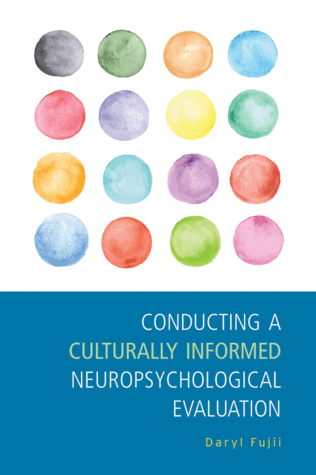
Conducting a Culturally Informed Neuropsychological Evaluation
ISBN: 978-1-4338-2294-0Neuropsychologists learn a standard process for conducting a neuropsychological evaluation, but sound assessment of client functioning requires a clear understanding of his or her unique cultural context.
This is especially true when the client and the clinician do not share the same ethnic background and language fluency. In such cases, the clinician risks administering a biased assessment with invalid tests, misinterpreted data, and inappropriate — if not harmful — treatment recommendations.
Daryl Fujii helps neuropsychologists enhance their cultural competence by providing readers with a broad framework for cultivating an ethnorelative — instead of an ethnocentric — view of clients.
He begins by reviewing relevant research and professional guidelines that explain how cultural factors can impact a neuropsychological evaluation. He then outlines preliminary strategies for establishing rapport and improving communication with clients, estimating their premorbid functioning, gathering pertinent data, selecting and translating appropriate tests, and working with interpreters.
The closing chapters present a detailed case example that demonstrates a preassessment interview, test interpretation, report writing, treatment recommendations, and a final feedback session with the client.
Acknowledgments
Introduction
I. Foundations: Attitudes, Perspective, and Conceptual Overview
- A Respect for Culture
- Conceptual Guidelines: APA, AACN, AERA, and NCMA
II. Preparation
- Creating a Cultural Context
- Conceptualizing Goals and Cultural Considerations
- Estimating Premorbid Functioning
- Strategies for Test Selection and Data Collection
- A Mini-Compendium of Neuropsychological Tests With Cross-Cultural Validity
III. Evaluation and Report Writing
- Conducting the Evaluation
- Interpretation and Case Formulation
- Writing the Report and Providing Feedback
Appendix: Cultural Resources
References
Index
About the Author
Daryl Fujii, PhD, ABPP-CN, is a staff neuropsychologist at the Veterans Affairs Pacific Island Health Care Services Community Living Center and adjunct faculty for the Department of Psychiatry, University of Hawaii. He received his PhD from the University of Wyoming in 1991, interned at the Sepulveda Veterans Administration Medical Center, and completed a postdoctoral fellowship at the Rehabilitation Hospital of the Pacific.
Dr. Fujii earned his diplomate in clinical neuropsychology from the American Board of Professional Psychology in 1999 and was elected to fellow status of APA in 2006.
His research interests include cross-cultural neuropsychology, schizophrenia, geriatrics, secondary psychosis, and psychosis secondary to traumatic brain injury, for which he is an international forensic consultant. He has more than 50 publications, including two edited books: The Spectrum of Psychotic Disorders: Neurobiology, Etiology, and Pathogenesis (2007) and The Neuropsychology of Asian-Americans (2011).
Dr. Fujii is currently a co-chair of the national VA Psychology Training Committee, Multicultural Diversity Committee and chair of the VA Pacific Island Health Care Services and VA Central California Health Care System.
This book is a must-read for clinicians and researchers alike. It is replete with interesting and informative examples, along with supportive references, concerning differences in learning experiences, values, and communication styles that affect how the culturally different client approaches and performs in the testing situation. It provides conceptual and practical elements that will enhance obtaining valid neuropsychological test results and interpreting findings from people with different backgrounds than our own. There is no way one can read this book and fail to come away with increased sensitivity and practical knowledge.
—Robert K. Heaton, PhD, ABPP-CN, Distinguished Professor of Psychiatry, University of California at San Diego
Each passing year brings a richer patient diversity to the office practices of North American neuropsychologists, whether related to ethnicity, important beliefs and values, language, or more broadly construed as cross-cultural diversity. Fujii has compiled a thoughtful, scholarly, and yet practical and generously instructive text that will assist trainees and practicing clinicians in meeting the challenges of cross-cultural diversity via culturally informed neuropsychological practice.
—Jerry J. Sweet, PhD, ABPP, Director, Neuropsychology Service, NorthShore University HealthSystem, Teaching Affiliate of the University of Chicago Pritzker School of Medicine, Evanston, IL