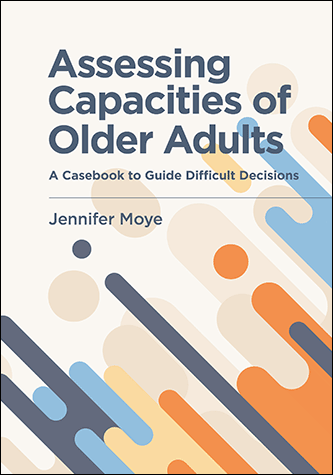
Assessing Capacities of Older Adults
Available formats
Also available from
- Doody's Core Title
This book demonstrates how to address practical and ethical challenges when evaluating capacities of older adults with neurocognitive disorders, like dementia.
The contributors are expert clinicians who draw upon real‑life experiences conducting clinical capacity assessments in civil matters, illustrating best practices from the ABA/APA’s Assessment of Older Adults With Diminished Capacity: A Handbook for Psychologists (PDF, 1.3MB)opens in new window.
Chapters cover complex and difficult issues in careful detail, including:
- financial exploitation
- undue influence
- sexual consent
- medical aid in dying
The author also provides guidance for negotiating family conflicts, working with surrogate decision‑makers who also have diminished capacity, coordinating with medical and legal professionals, and addressing other situations that involve multiple stakeholders with competing priorities.
A recurring theme throughout the volume is the challenge of balancing a client’s right to autonomy, while also protecting them from harm. The book offers careful, effective advice for keeping clients who lack decision‑making capacity involved in their healthcare choices and working to maintain their independence when daily living skills are impaired.
Contributors
Acknowledgments
Introduction
Jennifer Moye
- Understanding Legal and Clinical Capacities
Jennifer Moye and Erica Wood
I. Capacities in Diagnostic Contexts
- Evaluating Capacities in Persons with Dementia
Kyle S. Page and Kathleen C. Matthews - Evaluating Capacities in Persons with Serious Mental Illness
Jessica V. Strong, Brian M. Ludwin, and Scott C. Fish - Evaluating Capacities After Traumatic Brain Injury
Kristen Triebel, Sean D. Hollis, and Thomas A. Novack
II. Capacities in the Setting of Elder Abuse and Exploitation
- Assessment of Financial Exploitation
Peter A. Lichtenberg - Assessment of Undue Influence
Stacey Wood - Assessment of Independent Living Capacity in the Context of Elder Self-Neglect
Michelle E. Mlinac and Pamela Steadman-Wood - Assessment of Testamentary Capacity
Daniel C. Marson
III. Evolving Issues in Assessing Capacities
- Assessment of Sexual Consent Capacity
Emma Katz, Rachael Spalding, Jarred V. Gallegos, and Barry Edelstein - Assessment of Capacity in Medical Aid in Dying
Brian D. Carpenter and C. Caroline Merz
IV. Negotiating Challenges With Families and Surrogates
- Working With Surrogates Who May Lack Capacity or Be Unfit
Kate L. M. Hinrichs and Ronald W. Smith - Addressing Family Conflicts When Assessing Capacities
Amy E. Albright, Michelle M. Hilgeman, and Rebecca S. Allen
Index
About the Editor
Jennifer Moye, PhD, is the associate director of education and evaluation for New England Geriatric Research Education and Clinical Center (GRECC) at the VA Boston Healthcare System and Bedford VA Medical Center and professor of psychology in the department of psychiatry at Harvard Medical School.
She received her doctorate from the University of Minnesota in 1992.
She is the editor-in-chief of Clinical Gerontologist.
Her main research interests concern capacity, guardianship, and adjustment to medical illness in older adults, as well as geriatrics and gerontology education.
Jennifer Moye lives in Boston, Massachusetts.
Follow @JenniferMoyePhD on Twitter.
Overall, contributors stress decision making in a relational context (caregivers and surrogates), and introduce the construct of the so-called Complexity, Urgency, Risk and Environment Framework (CURE), a planning tool for responsible capacity assessment… Recommended.
—Choice