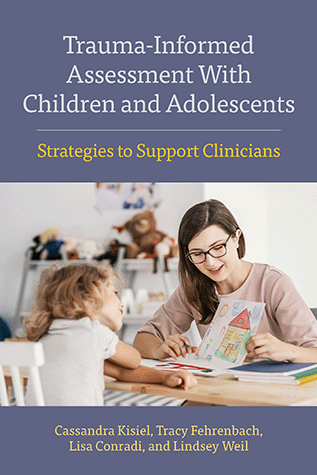
Trauma-Informed Assessment With Children and Adolescents
This book serves as a practical guide for clinicians and other professionals working with children and adolescents exposed to trauma, offering an overview and rationale for a comprehensive approach to trauma-informed assessment, including key domains and techniques.
Building on more than 2 decades of work in collaboration with the National Child Traumatic Stress Network (NCTSN), the book provides strategies for conducting an effective trauma-informed assessment that can be used in practice to support the treatment planning and intervention process, family engagement and education, and collaboration and advocacy with other providers.
As part of APA’s Division 56 series, Concise Guides on Trauma Care, the book surveys a range of recommended tools and considerations for selecting and implementing those tools across stages of development and in relation to a child’s sociocultural context.
The authors also examine challenges that may arise in the context of trauma-informed assessment and suggest approaches to overcome those barriers.
Introduction
- Overview and Key Domains of Comprehensive Trauma Informed Assessment
- Key Process Elements of a Trauma Informed Assessment
- Selecting and Implementing Trauma Informed Assessment Tools for Children and Adolescents
- Tailoring the Assessment to the Socio-cultural Context of the Child and Family
- Collaborative and Meaningful Applications of Trauma-Informed Assessment
- Conclusions and Future Directions
Cassandra Kisiel, PhD, is a clinical psychologist and associate professor at Northwestern Medicine, and also is the primary trauma consultant for the Children and Family Services Department in Illinois. With almost 20 years of experience and a specialization in developmental trauma and child trauma assessment, she has lectured and written on children’s exposure to trauma.
Dr. Kisiel also helped to develop the Child and Adolescent Needs and Strengths (CANS)-Trauma, which aids children throughout the country in a variety of settings.
Tracy Fehrenbach, PhD, is an assistant professor of psychiatry and behavioral sciences at Northwestern Medicine, and has published many articles on the child trauma and the child welfare systems. She is particularly interested in trauma, namely the assessment, diagnosis and treatment of women and children, with consideration to underserved populations.
Dr. Fehrenbach also is interested in ensuring that services are culturally sensitive and relevant for a variety of cultures.
Lisa Conradi, PsyD, is the director of clinical operations at the Chadwick Center for Children and Families at Rady Children’s Hospital-San Diego, where she oversees all clinical programs at one of the largest trauma treatment centers in the nation.
Dr. Conradi has authored and coauthored a variety of publications on trauma screening and assessment practices and creating trauma-informed systems, and has presented nationally on innovative practices designed to improve the service delivery system for children who have experienced trauma. She is one of the developers of the second edition of the Child Welfare Trauma Training Toolkit.
Lindsey Weil, PhD, received her PhD from the Clinical Psychology program at Northwestern University, at the Feinberg School of Medicine. Her research involves the health and well-being for those in the child welfare system, and meaningful use of trauma assessment.
Alongside her PhD, Dr. Weil has focused on community well-being, working both at a community mental health agency as well as conducting research on adolescent girls in the juvenile correctional system.