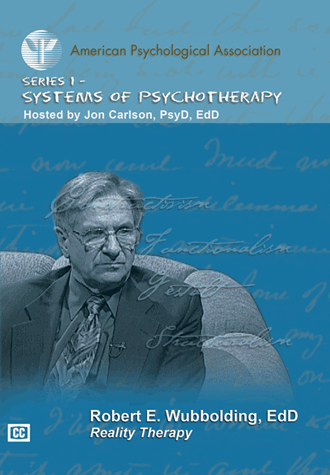
Reality Therapy
ISBN: 978-1-59147-788-4Available formats
Streaming options
In Reality Therapy, Dr. Robert E. Wubbolding demonstrates this choice-centered approach. Reality therapy is based on choice theory, which states that people choose their behaviors to do one of two things: fulfill a need or communicate with the surrounding world. Reality therapy first assesses what the clients' needs are and what they want from therapy. The therapist conducts an assessment to help clients determine how effective their behaviors have been in fulfilling their needs and then works with clients to determine a plan for more effective action.
In this session, Dr. Wubbolding works with a man in his 40s who has relationship difficulties because of his communication style. Dr. Wubbolding helps the client to look at his relationship differently and to try to see things from his girlfriend's point of view.
Choice theory provides the basis for reality therapy. It stresses that human behavior originates from five current sources of motivation or five human needs: Self-preservation, belonging, power or inner control, freedom or independence, and fun or enjoyment. Most behaviors are chosen and serve two purposes: to impact the environment around us in order to satisfy the five needs and send a message to or communicate with the surrounding world.
Reality therapy, the delivery methodology, is best summarized as the WDEP (Wants, Doing, Evaluation, and Planning) system. Each letter represents a cluster of interventions.
- W stands for asking clients what they want from the therapy, from their families, from themselves, and in general from the world around them.
- D represents a discussion of current behavior which includes actions, cognitions or self-talk, and emotions.
- Self-Evaluation constitutes the core of the delivery system. Therapists help clients conduct a searching assessment of the effectiveness of their behavior, especially actions, the attainability of their wants and the validity of their perceived locus of control. Reality Therapy for the 21st Century (Wubbolding, 2000) describes 22 kinds of self-evaluation.
- P includes both linear and paradoxical plans that are specific, attainable and repetitive. The plans are designed to increase belonging, power or inner control, freedom or independence, and fun or enjoyment.
Reality therapy began in a mental hospital and a correctional institution. Consequently, reality therapists apply the WDEP system to a wide range of mental health issues. Participants attending training sessions frequently want to gain specific skills for dealing with resistance, denial and related issues.
Reality therapy is most applicable in cultures that regard free choice as a positive value. Individuals not respecting the rights of others are less likely to benefit from any system based on personal responsibility and humanitarian values.
Robert E. Wubbolding, EdD, is director of the Center for Reality Therapy and director of training for the William Glasser Institute, and has taught reality therapy in North America, Asia, Europe, and the Middle East.
The author of 10 books on reality therapy, he has expanded and extended this practical method by formulating it as the WDEP (Wants, Doing, Evaluation, and Planning) system and adapting it to cross-cultural therapy. Among his books is the most comprehensive book on reality therapy, Reality Therapy for the 21st Century (2000), in which he extends the procedures, describes their use in cross-cultural counseling, and summarizes research from around the world.
How to use the Theories of Psychotherapy Series® in combination with APA Videos
- Glasser, W. (1998). Choice theory: A new psychology of personal freedom. New York: Harper.
- Wubbolding, R. E. (2000). Reality therapy for the 21st century. Philadelphia: Taylor & Francis.
- Wubbolding, R. E., & Brickell, J. (2001). A set of directions for putting and keeping yourself together. Minneapolis, MN: Educational Media Corporation.
- Wubbolding, R. E. WDEP: A Group Reality Therapy Approach (DVD)
APA Videos
- Constructivist Therapy
Robert A. Neimeyer - Consulting With Teachers
Jon Carlson and William Glasser - Couple Power Therapy
Peter L. Sheras and Phyllis R. Koch-Sheras - Couples at an Impasse
Jon Carlson - Gestalt Therapy
Gordon Wheeler - Psychotherapy With Men
Mark A. Stevens
APA Books
- Flourishing: Positive Psychology and the Life Well-Lived
Edited by Corey L. M. Keyes and Jonathan Haidt - Insight in Psychotherapy
Edited by Louis G. Castonguay and Clara E. Hill
- Reality Therapy
This book presents and explores reality therapy, its theory, history, therapy process, primary change mechanisms, the empirical basis for its effectiveness, and contemporary and future developments.