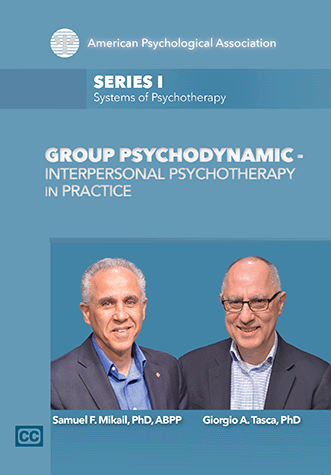
Group Psychodynamic-Interpersonal Psychotherapy in Practice
ISBN: 978-1-4338-3270-3Available formats
Streaming options
In this video program, Drs. Samuel F. Mikail and Giorgio A. Tasca discuss and demonstrate their approach to group therapy with Group Psychodynamic Interpersonal Psychotherapy (GPIP), a model that uses a transdiagnostic approach to conceptualizing disorders and problems that bring patients to seek psychotherapy.
This approach effectively integrates psychodynamic, attachment-based, and interpersonal models to foster client personality functions under a coherent framework. The model conceptualizes Malan’s triangle of conflict as a triangle of adaptation, such that unmet attachment needs or problems with adaptive emotions lead to inhibitory affects, which in turn may require maladaptive defense mechanisms as a means of coping.
In this video, Dr. Cheri L. Marmarosh interviews both Drs. Samuel F. Mikail and Giorgio A. Tasca about the development and efficacy of their approach, while Dr. Samuel F. Mikail conducts a group therapy session with five African-American male clients with ages spanning three generation groups.
The clients featured in the therapy demonstration discuss various issues and life events, while Dr. Mikail demonstrates how individuals with different attachment histories may navigate their initial experience in a group.
This intrapersonal dynamic has interpersonal consequences in terms of maladaptive cyclical relational patters (CRP; Strupp and Binder, 1984) that can cause interpersonal distress and lower social support.
In a pregroup preparation and assessment, individual case conceptualizations are formed based on the triangle of adaptation and the CRP; treatment goals are developed and discussed; and the client is socialized to the norms of group therapy including self-disclosure, self-reflection, and interpersonal feedback.
A key aspect of GPIP integrates a group development approach into the model to guide therapists’ interventions. That is, in early sessions GPIP therapists focus on creating a sense of security and group cohesion as well as group norms, in middle sessions therapists help clients change their intrapersonal and interpersonal patterns by examining in-group interactions facilitating interpersonal feedback, and in late session therapists help clients to consolidate these changes and work through issues related to termination and relapse prevention.
Giorgio A. Tasca, PhD, is a professor in the School of Psychology at the University of Ottawa, and holds a cross-appointment in the Department of Psychiatry. He is the director of the Psychotherapy Practice Research Network, whose mission is to improve psychotherapists’ effectiveness and patient mental health outcomes.
He is a past president of the American Psychological Association Society of Group Psychology and Group Psychotherapy (Div. 49), and is the incoming editor of the journal Group Dynamics.
He is also a visiting professor at the University of Bergamo, and Scientific Director of the Scuola di Psicoterapia Integrata Bergamo.
His publications include clinical trials of Group Psychodynamic Interpersonal Psychotherapy, and research on the role of attachment theory in predicting group therapy processes and outcomes.
Samuel F. Mikail, PhD, is senior consultant, Mental Health with Sun Life Financial and an adjunct faculty member at the University of Waterloo, Centre for Mental Health Research and Treatment.
He also maintains a private practice in Newmarket, ON. He is board certified in clinical psychology with the American Board of Professional Psychology.
Dr. Mikail has served on the Board of Directors of several professional associations.
Bateman, A. & Fonagy, P. (2013). Mentalization-based treatment. Psychoanalytic Inquiry, 33, 595-613.
Bowlby, J. (1980). A secure base. New York: Routledge.
Hewitt, P. L., Mikail, S. F., Flett, G. L., Tasca, G. A., Flynn, C. A., Deng, X., ... & Chen, C. (2015). Psychodynamic/interpersonal group psychotherapy for perfectionism: Evaluating the effectiveness of a short-term treatment. Psychotherapy,52, 205-217.
Hewitt, P., Flett, G., & Mikail, S.F. (2017). Perfectionism:A relational approach to conceptualization, assessment, and treatment. New York: Guilford.
Kiesler, D.J. (1996). Contemporary interpersonal theory and research: Personality,psychopathology and psychotherapy. New York: John Wiley & Sons.
Lingiardi, V. & McWilliams, N. (2017). The Psychodynamic Diagnostic Manual Version2(PDM-2). New York: Guilford. 2
Malan, D. (1979). Individual psychotherapy and the science of psychodynamics. London, Butterworth.
Plutchik, R. & Hope, R.C. (1997). Circumplex models of personality and emotions. Washigton, D.C.: American Psychological Association.
Strupp, H.H. & Binder, J. (1984). Psychotherapy in a new key: A guide to time-limited dynamic psychotherapy. New York: Basic Books.
Tasca, G.A., Ritchie, K., Conrad, G., Balfour, L., Gayton, J., .... Bissada, H. (2006). Attachment scales predict outcomes in a randomized controlled trial of two group therapies for binge eating disorder: An aptitude by treatment interaction. Psychotherapy Research, 16, 106- 121.
Tasca GA, Ritchie K, Demidenko N, Balfour L, Krysanski V, Weekes K, ... Bissada H. (2013). Matching women with binge eating disorder to group treatment based on attachment anxiety: outcomes and moderating effects. Psychotherapy Research, 23, 301-314.
Tasca, G.A., Koszycki, D., Brugnera, A., Chyurlia, L., Hammond, N., ... Balfour, L. (2018). Testing a stepped care model for binge-eating disorder: A two-step randomized controlled trial. Psychological Medicine. Published online May, 2018: https://doi.org/10.1017/S0033291718001277
APA Videos
- Attachment in Group Therapy: Facilitating the Group Climate
Cheri L. Marmarosh - Attachment-Based Psychotherapy in Practice
Peter C. Costello - The Therapy Relationship
Charles G. Gelso - Using Client Feedback in Therapy
Barry L. Duncan - Family Therapy With Patients Having Physical Health Problems
Susan H. McDaniel - Mindfulness for Well-Being
Rezvan Ameli - Intimate Partner Violence
Casey T. Taft
APA Books
- Group Psychodynamic Interpersonal Psychotherapy
Giorgio A. Tasca, Samuel F. Mikail, and Paul L. Hewitt - Attachment in Group Psychotherapy
Cheri L. Marmarosh, Rayna D. Markin, and Eric B. Spiegel - Attachment-Based Family Therapy for Depressed Adolescents
Guy S. Diamond, Gary M. Diamond, and Suzanne A. Levy - Attachment-Based Psychotherapy: Helping Patients Develop Adaptive Capacities
Peter C. Costello - Grief in Childhood: Fundamentals of Treatment in Clinical Practice
Michelle Y. Pearlman, Karen D'Angelo Schwalbe, and Marylène Cloitre - Inside the Session: What Really Happens in Psychotherapy
Paul L. Wachtel - Insight in Psychotherapy
Edited by Louis G. Castonguay and Clara E. Hill - The Real Relationship in Psychotherapy: The Hidden Foundation of Change
Charles J. Gelso