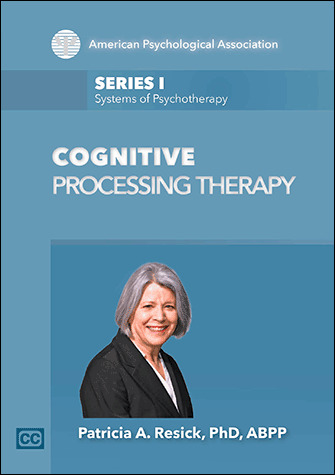
Cognitive Processing Therapy
ISBN: 978-1-4338-3127-0Available formats
Streaming options
Cognitive processing therapy is an effective approach to reducing PTSD symptoms related to a variety of traumatic events, including child abuse, combat, rape, and natural disasters.
Guest therapist Patricia A. Resick, PhD, ABPP, developed cognitive processing therapy to provide a clear, teachable method for working with clients who have experienced trauma, and the approach has since been endorsed by the U.S. Department of Veterans Affairs, the International Society of Traumatic Stress Studies, and most recently, by APA in its Clinical Practice Guideline for the Treatment of Posttraumatic Stress Disorder.
In this video, Dr. Resick discusses her approach with a panel of mental health practitioners, then demonstrates cognitive processing therapy with a client who has experienced significant trauma and now has symptoms of PTSD.
This session features a client portrayed by an actor on the basis of a composite of different cases.
Cognitive processing therapy (CPT) is a cognitive treatment for posttraumatic stress disorder (PTSD).
CPT was developed in the late 1980s and has been shown to be effective in reducing PTSD symptoms related to a variety of traumatic events including child abuse, combat, rape and natural disasters. CPT is endorsed by the U.S. Departments of Veterans Affairs and Defense, as well as the International Society of Traumatic Stress Studies and APA as a best practice for the treatment of PTSD.
CPT can be implemented individually, in groups and in combination. It can be a set number of 12 sessions or variable length.
There have been 23 randomized controlled trials on the effectiveness of CPT and many effectiveness trials. A number of other controlled trials are currently underway as well as dissemination projects in a number of countries.
After earning her doctorate from the University of Georgia, Dr. Patricia A. Resick served as assistant to associate professor at the University of South Dakota, and associate to full professor at the University of Missouri–St. Louis, where she was awarded an endowed professorship, Curator's Professor in 2000. During that time she developed and was director of the Center for Trauma Recovery.
In 2003, Dr. Resick became director of the Women's Health Sciences Division of the National Center for PTSD, VA Boston Healthcare System and professor of psychiatry at Boston University. In 2013, she joined Duke University.
Dr. Resick's specialty is understanding and treating the effects of traumatic events, particularly posttraumatic stress disorder (PTSD). She developed cognitive processing therapy for PTSD.
Dr. Resick's research has been continuously funded for 40 years; she has published more than 300 articles and chapters and 10 books.
She has served as president of both the International Society for Traumatic Stress Studies (ISTSS) and Association for Behavioral and Cognitive Therapies (ABCT). She has won research and mentoring awards from ISTSS and ABCT as well as the Lifetime Achievement Award from two APA divisions.
APA Videos
- Cognitive Behavioral Interventions for Posttraumatic Stress Disorder
Candice M. Monson - Cognitive Behavioral Therapy Over Time
Amy Wenzel - Cognitive–Behavioral Therapy Strategies
Keith S. Dobson - Cognitive Restructuring of Automatic Thoughts
Keith S. Dobson, Pamela A. Hays, and Amy Wenzel - Complex Posttraumatic Stress Disorder
Steven N. Gold - Core Belief Work and Acceptance
Keith S. Dobson, Pamela A. Hays, and Amy Wenzel - Intimate Partner Violence
Casey T. Taft
APA Books
- Behavioral Interventions in Cognitive Behavior Therapy: Practical Guidance for Putting Theory Into Action, Second Edition
Richard F. Farmer and Alexander L. Chapman - Cognitive–Behavioral Therapy, Second Edition
Michelle G. Craske - A Practical Guide to PTSD Treatment: Pharmacological and Psychotherapeutic Approaches
Nancy C. Bernardy and Matthew J. Friedman - Trauma-Informed Treatment and Prevention of Intimate Partner Violence
Casey T. Taft, Christopher M. Murphy, and Suzannah K. Creech - Treating PTSD With Cognitive-Behavioral Therapies: Interventions That Work
Candice M. Monson and Philippe Shnaider