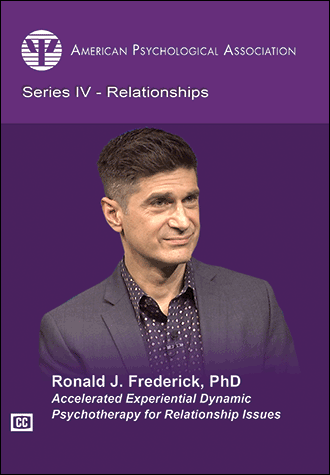
Accelerated Experiential Dynamic Psychotherapy for Relationship Issues
ISBN: 978-1-4338-3263-5Available formats
Streaming options
Many presenting issues, from psychopathology to anxiety to relationship issues, can result from an individual having been alone in the face of overwhelming and painful emotions. The core of accelerated experiential dynamic psychotherapy (AEDP) is helping clients experience previously feared-to-be-unbearable emotions in the context of an emotionally engaged, therapeutic relationship, and subsequently processing these emotions to completion.
This process releases adaptive tendencies and provides the central agent of change in AEDP as clients regain access to resources and resilience that have been unavailable because of their emotional defenses.
In this video program, Dr. Ron Frederick demonstrates how to use AEDP with a client who is experiencing relationships issues. In the session, Frederick works with a lesbian, Latinx woman who is unhappy in her current relationship.
Watch as he emphasizes emotional regulation and processing, taking special care to help the client work with feelings she has long defended against experiencing.
Accelerated Experiential Dynamic Psychotherapy (AEDP) is both a theory of transformational process and a model of psychotherapy with three fundamental elements
- Attachment
- Emotion Processing
- Transformation
Emphasizing the regulation and processing of relatedness and emotion, AEDP integrates psychodynamic and relational elements within an affect-centered experiential framework.
The function of a model is to tell us where to focus, and why; what to aim for in the clinical encounter; and then how to make it happen. In the AEDP model, AEDP metapsychology and metatherapeutics inform clinical work.
Metapsychology
As a theory, AEDP seeks to explain the quantum transformational nature of deep somatically based emotional experiencing in the context of a relationship with a trusted, “true other.” AEDP’s metapsychology is an adaptation-based model informed by attachment theory, affective neuroscience, developmental mother-infant interaction studies, and, last but not least, emotion theory (à la Darwin, Tomkins, Damasio, Ekman and co.).
It emphasizes the quantum nature of change and specifically identifies positive affects as wired-in agents, markers, and sequelae of that quantum transformation. (There is an entire phenomenology of positive affects—e.g., relational [the “we”] affects, transformational affects, healing affects, core state—that has been developed within AEDP, and it is still unfolding as we keep exploring.)
In keeping with its (biological/evolutionary) adaptation-based metapsychology (attachment theory and emotion theory fit right in—it is how we are wired after all), AEDP understands psychopathology as reflecting the client’s “best efforts” at adaptation in a maladaptive, skewed environment.
Thus, unlike, for instance, in a punitive-superego-based metapsychology where the self-destructive motivational vector has to be reversed, the vector of the client’s motivational vector does not have to be changed: The adaptive intentions on behalf of the self that drive the client’s attempts underlying even the most disturbed presentations have to be affirmed, all the while needing to process the need to change strategies that were once adaptive but are no longer, that were once “best efforts” given minimal resources (i.e., being a child, being helpless in a traumatic situation), whereas many more resources are available now.
Metatherapeutics
As a theory of treatment, AEDP is healing oriented. Rather than being informed by an understanding of what creates psychopathology, AEDP’s model of treatment is informed by an understanding emerging from transformational studies, a field devoted to elucidating the dynamics and phenomenology of healing, transformational processes that are at work naturally and/or in change-based systems.
So as to harness their healing power in treatment, AEDP seeks to learn from the naturalistic, healing, positive, transformational affective change processes that are at work in emotion, attachment, optimal mother-child interactions, and in the body’s self-righting tendencies.
Specifically reflected in its therapeutic stance, AEDP has sought to learn the lessons of good-enough (i.e., security-engendering) mothers and their good enough (i.e., securely attached, resilient) babies, thus being open to learning many lessons from good-enough Mother Nature.
The explosion of knowledge about how the brain processes and is organized by experiences of emotion and attachment roots AEDP’s explorations in the developing field of affective neuroscience.
Treatment
As a way of working with clients, AEDP features a therapeutic stance that is affirming, empathic, emotionally engaged, mutual (though not necessarily symmetrical), and affect-regulating therapeutic techniques—relational, experiential/affective, integrative—which rely on the moment-to-moment tracking of somatically based affective experience.
This therapeutic stance, optimally suited for the dyadic affect regulation that is central to how AEDP works, aims to foster the emergence of a securely attached client-therapist relationship; the techniques aim to facilitate access to adaptive emotional responses.
The aim of the treatment is that the client should have an experience, a new experience, and that the experience be good.
Understanding psychopathology as the result of the individual’s unwilled and unwanted aloneness in the face of overwhelming emotions, we seek to be there, together with the client. The client is not alone with painful, frightening emotions.
Viscerally experiencing previously feared-to-be-unbearable emotions in the context of an emotionally-engaged relationship with a trusted other, and being able to process these to completion until their adaptive action tendencies are released, is the central agent of change in AEDP. Clients thus (re)gain access to their resources and resilience, previously locked away with the warded off experiences.
Finally, another central and original aspect of AEDP is the focus on the experience of transformation—particularly the experience of the transformation of the self within an emotionally-connected relationship with a true other—as a healing transformational process in its own right.
Ronald J. Frederick, PhD, is a founding and senior faculty member of the AEDP Institute, cofounder of the Center for Courageous Living in Beverly Hills, CA, author of the books Loving Like You Mean It: Use the Power of Emotional Mindfulness to Transform Your Relationships (Central Recovery Press, 2019) and Living Like You Mean It: Use the Wisdom and Power of Your Emotions to Get the Life You Really Want (Jossey-Bass, 2009), and a recipient of APA’s Malyon-Smith Scholarship Award for his research on the fear of intimacy.
Extensively trained by Dr. Diana Fosha, the developer of AEDP, he has been practicing and teaching AEDP for more than 20 years and is actively involved in training and supervising psychotherapists internationally.
Noted for his warmth, humor, and engaging presentation style, Dr. Frederick regularly leads workshops, internationally, for professional and general audiences. He is a frequent presenter at the Esalen Institute, the Kripalu Center, and the Cape Cod Institute, and has provided professional trainings for the Lifespan Learning Institute, Professional Psychology Seminars, Premier Education Solutions, and national, state, and local organizations.
Fosha, D. (2013). Turbocharging the affects of healing and redressing the evolutionary tilt. In D. J. Siegel & Marion F. Solomon (Eds.), Healing moments in psychotherapy (pp. 129–168). New York: Norton.
Fosha, D. (2009). Emotion and recognition at work: Energy, vitality, pleasure, truth, desire, & the emergent phenomenology of transformational experience. In D. Fosha, D. J. Siegel, & M. F. Solomon (Eds.), The healing power of emotion: Affective neuroscience, development, clinical practice (pp. 172–203). New York: Norton.
Fosha, D. (2000). The transforming power of affect: A model for accelerated change. New York: Basic Books.
Fosha, D. (2008). Transformance, recognition of self by self, and effective action. In K. J. Schneider (Ed.), Existential-integrative psychotherapy: Guideposts to the core of practice (pp. 290–320). New York: Routledge.
Fosha, D. (2009). Healing attachment trauma with attachment (...And then some!). In M. Kerman (Ed.), Clinical pearls of wisdom: 21 leading therapists offer their key insights (pp. 43–56). New York: Norton.
Fosha, D. (2009). Positive affects and the transformation of suffering into flourishing. In W. C. Bushell, E. L. Olivo, & N. D. Theise (Eds.), Longevity, regeneration, and optimal health: Integrating Eastern and Western perspectives (pp. 252–261). New York: Annals of the New York Academy of Sciences.
Fosha, D., Paivio, S. C., Gleiser, K., & Ford, J. (2009). Experiential and emotion-focused therapy. In C. Courtois & J. D. Ford (Eds.), Complex traumatic stress disorders: An evidence-based clinician’s guide (pp. 286–311). New York: Guilford Press.
Fosha, D., Siegel, D. J., & Solomon, M. F. (Eds.). (2009). The healing power of emotion: Affective neuroscience, development, and clinical practice. New York: Norton.
APA Videos
- Accelerated Experiential Dynamic Psychotherapy
Diana Fosha - Accelerated Experiential Dynamic Psychotherapy (AEDP) With a Male Client
Diana Fosha - Accelerated Experiential Dynamic Psychotherapy Over Time
Diana Fosha - Emotion-Focused Couple Therapy
Rhonda Goldman - Therapy With Diverse Couples
Shalonda Kelly - Working With Trauma in Accelerated Experiential Dynamic Psychotherapy
SueAnne Piliero
APA Books
- The Dynamics of Infidelity: Applying Relationship Science to Psychotherapy Practice
Lawrence Josephs - Happy Together: Thriving as a Same-Sex Couple in Your Family, Workplace, and Community
Sharon S. Rosotosky and Ellen D. B. Riggle - Helping Couples on the Brink of Divorce: Discernment Counseling for Troubled Relationships
Wiliam J. Doherty and Steven M. Harris - Integrative Couple and Family Therapies: Treatment Models for Complex Clinical Issues
Edited by Patricia J. Pitta and Corinne C. Datchi - Supervision Essentials for Accelerated Experiential Dynamic Psychotherapy
Natasha C. N. Prenn and Diana Fosha