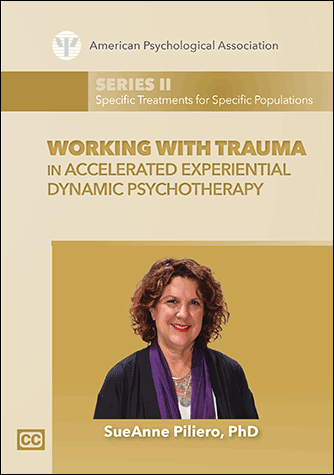
Working With Trauma in Accelerated Experiential Dynamic Psychotherapy
ISBN: 978-1-4338-3261-1Available formats
Streaming options
A traumatic experience, as perceived through the lens of accelerated experiential dynamic psychotherapy (AEDP), is the result of being left alone with an overwhelming emotional experience. To help clients who are dealing with the effects of such trauma, AEDP emphasizes the co-construction of a therapeutic relationship that includes establishing a secure attachment bond between the therapist and client and exploration of the affective traumatic experience.
This nonpathologizing, attachment and emotion transformation-focused psychotherapy places the somatic — the bodily sense — of the emotional experience at the center of how change is fostered. Therapy involves allowing the client to safely experience and process the emotion from past trauma within a deeply caring relationship.
In this video, Dr. SueAnne Piliero demonstrates this approach with an older African-American woman who has suffered major complex traumatic experiences throughout her life.
Accelerated experiential dynamic psychotherapy (AEDP), is one of the fastest growing approaches to transforming emotional suffering. Until recently, the mental health field focused on pathology and lacked concepts to capture the motivational strivings for health.
Drawing on neuroscience and developmental research, AEDP rectifies the bias toward pathology: Building on our natural resilience, its therapeutics is based on our innate healing capacities. We are wired for healing, self-righting, and for resuming impeded growth, which is what “transformance,” AEDP’s central construct, is all about.
Transformance identifies and names the wired-in motivational drive toward healing and self-repair present in all of us, and is a crucial ally in processing trauma and healing emotional suffering.
The methodology of AEDP has patient and therapist emotionally engaged, closely following the edge of emergent transformational experience, all the while processing trauma. Both are involved in the moment-to-moment tracking of subtle and not-so-subtle fluctuations in experience, energy, and connection.
AEDP emphasizes the co-creation of safety: with accompaniment, patients can risk revisiting past trauma and suffering. Healing and neuroplasticity are set in motion through fully experiencing previously feared emotions in a secure relationship, and through gentle, yet focused, explicit attention to the experience of healing within the patient–therapist relationship.
Processing both traumatic and restorative emotional experiences to completion, the AEDP process culminates in vitality, energy, and the non-finite positive emotion-fueled spirals of resilience, well-being, and creativity that are so highly correlated with health.
SueAnne Piliero, PhD, is senior faculty and a founding member of the AEDP Institute.
Dr. Piliero travels nationally and internationally to teach AEDP to a broad range of clinical audiences. She has given seminars and experiential workshops to various universities and health organizations nationwide.
Dr. Piliero is a lead trainer and a sought-after individual and small group consultant for clinicians around the world. She is known for her warm, engaging teaching style and her ability to communicate complex topics with humor and clarity. She is also known for her powerful clinical work. Her clinical videotapes demonstrate how even the most traumatized individuals can be transformed.
Dr. Piliero received her doctorate from Adelphi University, and her master’s degree in human development and psychology from Harvard. Her clinical interests and specialties are in trauma, PTSD, dissociation, and the ways in which the mind, body, and spirit are powerfully poised to transform them. She teaches, supervises and is in private practice in New York City.
Fosha, D. (2013). Turbocharging the affects of healing and redressing the evolutionary tilt. In D. J. Siegel & Marion F. Solomon (Eds.), Healing moments in psychotherapy (pp. 129–168). New York: Norton.
Fosha D. (2009). Emotion and recognition at work: Energy, vitality, pleasure, truth, desire, & the emergent phenomenology of transformational experience. In D. Fosha, D. J. Siegel, & M. F. Solomon (Eds.), The healing power of emotion: Affective neuroscience, development, clinical practice (pp. 172–203). New York: Norton.
Fosha, D. (2000). The transforming power of affect: A model for accelerated change. New York: Basic Books.
Fosha, D. (2008). Transformance, recognition of self by self, and effective action. In K. J. Schneider (Ed.), Existential-integrative psychotherapy: Guideposts to the core of practice (pp. 290–320). New York: Routledge.
Fosha, D. (2009). Healing attachment trauma with attachment (...And then some!). In M. Kerman (Ed.), Clinical pearls of wisdom: 21 leading therapists offer their key insights (pp. 43–56). New York: Norton.
Fosha, D. (2009). Positive affects and the transformation of suffering into flourishing. In W. C. Bushell, E. L. Olivo, & N. D. Theise (Eds.), Longevity, regeneration, and optimal health: Integrating Eastern and Western perspectives (pp. 252–261). New York: Annals of the New York Academy of Sciences.
Fosha, D., Paivio, S. C., Gleiser, K., & Ford, J. (2009). Experiential and emotion-focused therapy. In C. Courtois & J. D. Ford (Eds.), Complex traumatic stress disorders: An evidence-based clinician's guide (pp. 286–311). New York: Guilford Press.
Fosha, D., Siegel, D. J., & Solomon, M. F. (Eds.). (2009). The healing power of emotion: Affective neuroscience, development, and clinical practice. New York: Norton.
APA Videos
- Accelerated Experiential Dynamic Psychotherapy
Diana Fosha - Accelerated Experiential Dynamic Psychotherapy (AEDP) With a Male Client
Diana Fosha - Accelerated Experiential Dynamic Psychotherapy Over Time
Diana Fosha - Accelerated Experiential Dynamic Psychotherapy for Relationship Issues
Ron Frederick - Emotion-Focused Therapy for Trauma
Sandra C. Paivio - Trauma and Meaning
Jeanne M. Slattery - Working With Developmental Trauma
Julian D. Ford
APA Books
- Contextual Trauma Therapy: Overcoming Traumatization and Reaching Full Potential
Steven N. Gold - Existential–Humanistic Therapy, Second Edition
Kirk J. Schneider and Orah T. Krug - Narrative Processes in Emotion-Focused Therapy for Trauma
Sandra C. Paivio and Lynne E. Angus - Supervision Essentials for Accelerated Experiential Dynamic Psychotherapy
Natasha C. N. Prenn, LCSW, and Diana Fosha - Working With Narrative in Emotion-Focused Therapy: Changing Stories, Healing Lives
Lynne E. Angus and Leslie S. Greenberg