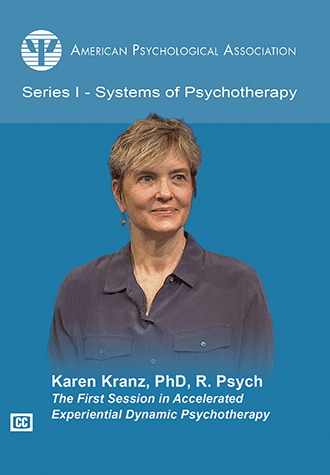
The First Session in Accelerated Experiential Dynamic Psychotherapy
ISBN: 978-1-4338-3377-9Available formats
Streaming options
In this video program, Dr. Karen Kranz demonstrates her approach to Accelerated Experiential Dynamic Psychotherapy, or AEDP, during the first session with a client. Engaging with the client emotionally, AEDP is a method that aims to provide a safe and secure attachment relationship with a trusted therapist and is co-created through dyadic affect regulation and undoing the client’s feelings of isolation.
Dr. Kranz’ approach to AEDP also emphasizes healing-oriented outcomes as opposed to pathology. Within this safe relationship, clients are helped to engage an innate transformational experience and express emotions that may have once been previously considered to be too overwhelming to experience alone.
In the therapy demonstration, Dr. Kranz works with the client to embrace a transformative healing change, from a core neurobiological standpoint.
The AEDP therapist embodies a non-pathologizing stance and is an emotionally engaged therapist. She helps bypass and befriend defenses and seeks to help clients embody, express, and experience core emotions, core self-states, and core relational needs which then elicit adaptive action tendencies and positive affective experiences.
Working experientially with the painful emotions associated with trauma, the AEDP therapist also processes the positive affects associated with healing through AEDP’s unique technique of meta-therapeutic processing. For example, processing the relief one feels to grieve in the presence of another what was unbearable to grieve alone.
The AEDP therapist uses the primary representational schema, the 4-state transformational process, to track moment-by-moment the distinct phenomenology associated with each state which in turn guides her interventions.
Attachment theory, emotion theory, transformational studies, caregiver-infant development studies, interpersonal neurobiology, somatically based trauma studies, psychodynamic theory, and positive neuroplasticity studies are the theoretical foundations of AEDP.
Dr. Karen Kranz is a psychologist based in Vancouver, British Columbia Canada and a senior faculty member at the AEDP Institute.
Her area of interest in AEDP involves making the work with clients increasingly more relational and experiential.
She teaches AEDP in the United States, Canada, Europe, Australia, and Brazil as well as supervises clinicians studying AEDP.
Fosha, D. (2000). The transforming power of affect: A model for accelerated change. New York: Basic Books
Fosha, D., Seigel, D. J., Solomon, M. F. (Eds.). (2009). The healing power of emotions: Affective neuroscience, development and clinical practice. New York: Norton.
Fosha, D. (2013). A heaven in a wildflower: Self, dissociation, and treatment in the context of the neurobiological core self. Psychoanalytic Inquiry, 33, 496-523.
Fosha, D. (2017). How to be a transformational therapist: AEDP harnesses innate healing affects to re-wire experience and accelerate transformation. In J. Loizzo, M. Neale & Wolf, (Eds.).
Advances in contemplative psychotherapy: Accelerating Transformation (pp.204-219)
APA Videos
- Accelerated Experiential Dynamic Psychotherapy for Relationship Issues
Ronald J. Frederick - Working With Trauma in Accelerated Experiential Dynamic Psychotherapy
SueAnne Piliero - Accelerated Experiential Dynamic Psychotherapy
Diana Fosha - Accelerated Experiential Dynamic Psychotherapy (AEDP) Supervision
Diana Fosha - Short-Term Dynamic Psychotherapy
Donald K. Freedheim - Existential–Humanistic Therapy Over Time
Kirk J. Schneider - Person-Centered Therapy Over Time
David J. Kain
APA Books
- Emotion-Focused Therapy for Depression
Leslie S. Greenberg and Jeanne C. Watson - Existential–Humanistic Therapy, Second Edition
Kirk J. Schneider and Orah T. Krug - Learning Emotion-Focused Therapy: The Process-Experiential Approach to Change
Robert Elliott, Jeanne C. Watson, Rhonda N. Goldman, and Leslie S. Greenberg - Supervision Essentials for Accelerated Experiential Dynamic Psychotherapy
Natasha C. N. Prenn and Diana Fosha - Transformation in Psychotherapy: Corrective Experiences Across Cognitive Behavioral, Humanistic, and Psychodynamic Approaches
Edited by Louis G. Castonguay and Clara E. Hill - Working With Narrative in Emotion-Focused Therapy: Changing Stories, Healing Lives
Lynne E. Angus and Leslie S. Greenberg