Community Psychology
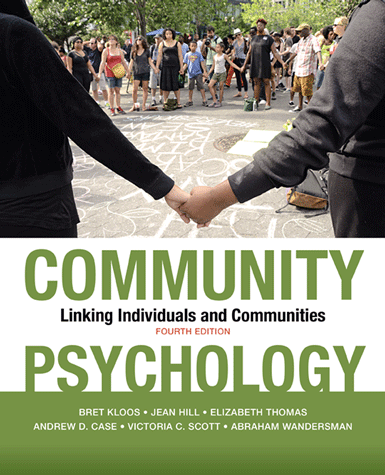
The fourth edition of this acclaimed textbook provides an in-depth and engaging overview of community psychology, including its theoretical underpinnings and methods for conducting research and promoting change within communities.
This book aims to get students, including nonpsychology majors, excited about the field and being agents of social change.
New to this edition are an increased focus on values, particularly those related to social justice, empowering minority communities, and solving complex societal problems—like poverty, oppression, and climate change—across multiple ecological levels.
New research and case examples present important developments in the field and society at large, accompanied by extensive discussion questions that will encourage self-reflection and help students apply key concepts to their own lives. A new marginal glossary also highlights important concepts.
Preface
Part I. Introducing Community Psychology
- What is Community Psychology?
- The Development and Practice of Community Psychology
Part II: Community Research
- The Aims of Community Research
- Methods for Community Psychology Research
Part III: Understanding Communities
- Understanding Individuals Within Environments
- Understanding Community
- Understanding Human Diversity in Context
Part IV: Collective and Community Responses to Challenges
- Empowerment and Citizen Participation
- Understanding Stress and Coping in Context
Part V: Preventing Problems and Promoting Social Competence
- Prevention and Promotion: Key Concepts
- Program Implementation
- Program Evaluation and Program Development
Part VI: Using Community Psychology to Promote Community and Social Change
- Community and Social Change
- Emerging Challenges and Opportunities: Using Community Psychology’s Shift in Perspective to Promote Change
Bret Kloos, PhD, is Professor of Psychology and Director of the Clinical-Community Psychology Doctoral Program at the University of South Carolina. He uses community psychology approaches to conceptualize, investigate, and intervene with human problems typically overlooked by clinical settings.
His work has focused on social inclusion for persons with psychiatric disabilities, housing and homelessness, mutual help, and social change approaches to promoting mental health. He teaches courses in community psychology, including service learning, and has served as the President of the Society for Community Research and Action.
Jean Hill, PhD, is Professor Emeritus of Psychology at New Mexico Highlands University and the Executive Director of the Society for Community Research and Action and has served as the President of the Society for Community Research and Action.
She has worked on school-based prevention and promotion programs and helped lead a community-wide initiative based on the Communities That Care model. She has written on sense of community, the role of spirituality in the field of community psychology, and the intersection of feminism and community psychology.
Elizabeth Thomas, PhD, is Professor of Psychology and Plough Chair of Urban Studies at Rhodes College in Memphis, TN. She teaches undergraduate courses in Community Psychology, Research Methods, and Urban Studies, and she supervises students in engaged learning and research from introductory courses to senior capstones.
Her research with undergraduate students and community partners focuses on learning and civic engagement, the role of arts in community building, and participatory strategies for research and action with youth. She has served as Editor of The Community Psychologist and Secretary of the Society for Community Research and Action.
Andrew D. Case, PhD, is Assistant Professor of Psychological Science, core faculty in the Community Psychology graduate program, and an affiliate faculty in the Public Health Sciences graduate program at University of North Carolina at Charlotte. He teaches courses in community psychology, health psychology, and diversity. He helps inform community efforts to reduce racial inequities in health, economic mobility, and the justice system.
His scholarship spans areas including counterspaces and social determinants of health. He has served on the Research Council of the Society of Community Research and Action and the editorial board of the American Journal of Community Psychology.
Victoria C. Scott, PhD, MBA is Assistant Professor of Psychological Science at the University of North Carolina at Charlotte and core faculty of her department’s graduate Community Psychology program. Drawing on interdisciplinary approaches, Dr. Scott works in community settings to promote health equity and collective wellness through systems-level improvement and capacity building efforts.
She cofounded the Global Journal of Community Psychology Practice, and has served as Administrative Director of the Society of Community Research and Action.
Abraham Wandersman, PhD, is President and CEO of the Wandersman Center and Distinguished Professor Emeritus at the University of South Carolina. He retired from the university in 2017.
He continues work in program evaluation and community psychology and transdisciplinary research and action at the Wandersman Center. Dr. Wandersman served as the president of the Society for Community Research and Action.
Supplemental resources require an APA account and approval from APA to access. Please create or log inlogin required to your account and return to this page to download materials. Please note: After logging in, you may still need to be approved by APA staff to access secure content.
Students can access downloadable chapter summaries, a glossary of key terms from each chapter, practice multiple-choice quizzes, and a list of recommend readings and videos to supplement each chapter.
Chapter Summaries
This file contains a brief summary of each chapter, highlighting key topics covered throughout Community Psychology, Fourth Edition.
- Chapter summaries (PDF: 43KBopens in new window | Microsoft Wordopens in new window)
Glossary
This file compiles the marginal glossaries from each chapter into a single document..
- Glossary of key terms (PDF: 104KBopens in new window | Microsoft Wordopens in new window)
Practice Quizzes
Below are multiple-choice quizzes for each chapter to help students test their knowledge about key concepts and prepare for quizzes and tests assigned by their instructors. Each quiz is accompanied by an answer key in which the correct answer to each question is presented in boldface.
- Chapter 1: The Fundamentals of Community Psychology
Practice Quiz (PDF: 24KBopens in new window | Microsoft Wordopens in new window)
Answer Key (PDF: 24KBopens in new window | Microsoft Wordopens in new window) - Chapter 2: The Development and Practice of Community Psychology
Practice Quiz (PDF: 23KBopens in new window | Microsoft Wordopens in new window)
Answer Key (PDF: 22KBopens in new window | Microsoft Wordopens in new window) - Chapter 3: The Aims of Community Research
Practice Quiz (PDF: 24KBopens in new window | Microsoft Wordopens in new window)
Answer Key (PDF: 23KBopens in new window | Microsoft Wordopens in new window) - Chapter 4: Methods of Community Psychology Research
Practice Quiz (PDF: 22KBopens in new window | Microsoft Wordopens in new window)
Answer Key (PDF: 22KBopens in new window | Microsoft Wordopens in new window) - Chapter 5: Understanding Individuals Within Environments
Practice Quiz (PDF: 23KBopens in new window | Microsoft Wordopens in new window)
Answer Key (PDF: 22KBopens in new window | Microsoft Wordopens in new window) - Chapter 6: What Defines Community?
Practice Quiz (PDF: 23KBopens in new window | Microsoft Wordopens in new window)
Answer Key (PDF: 22KBopens in new window | Microsoft Wordopens in new window) - Chapter 7: Understanding Human Diversity in Context
Practice Quiz (PDF: 24KBopens in new window | Microsoft Wordopens in new window)
Answer Key (PDF: 23KBopens in new window | Microsoft Wordopens in new window) - Chapter 8: Empowerment and Citizen Participation
Practice Quiz (PDF: 52KBopens in new window | Microsoft Wordopens in new window)
Answer Key (PDF: 51KBopens in new window | Microsoft Wordopens in new window) - Chapter 9: Understanding Stress and Coping in Context
Practice Quiz (PDF: 24KBopens in new window | Microsoft Wordopens in new window)
Answer Key (PDF: 24KBopens in new window | Microsoft Wordopens in new window) - Chapter 10: Key Concepts in the Science of Prevention and Promotion
Practice Quiz (PDF: 24KBopens in new window | Microsoft Wordopens in new window)
Answer Key (PDF: 23KBopens in new window | Microsoft Wordopens in new window) - Chapter 11: Implementing Prevention and Promotion Programs
Practice Quiz (PDF: 26KBopens in new window | Microsoft Wordopens in new window)
Answer Key (PDF: 25KBopens in new window | Microsoft Wordopens in new window) - Chapter 12: Program Development, Evaluation, and Improvement
Practice Quiz (PDF: 22KBopens in new window | Microsoft Wordopens in new window)
Answer Key (PDF: 21KBopens in new window | Microsoft Wordopens in new window) - Chapter 13: Improving Society Through Community Action
Practice Quiz (PDF: 25KBopens in new window | Microsoft Wordopens in new window)
Answer Key (PDF: 24KBopens in new window | Microsoft Wordopens in new window) - Chapter 14: Emerging Challenges and Opportunities: Shifting Perspective to Promote Change
Practice Quiz (PDF: 22KBopens in new window | Microsoft Wordopens in new window)
Answer Key (PDF: 21KBopens in new window | Microsoft Wordopens in new window)