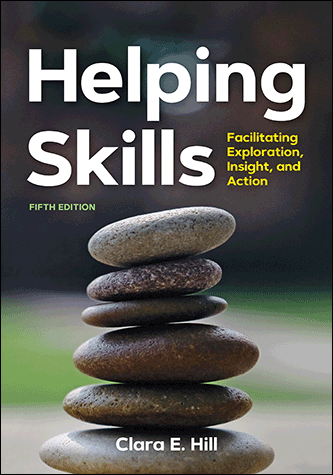
Helping Skills
In this fifth edition of her best-selling textbook, Clara Hill presents an updated model of essential helping skills for undergraduate and first-year graduate students.
Hill's model consists of three stages — exploration, insight, and action — in which helpers guide clients in exploring their thoughts and feelings, discovering the origins and consequences of maladaptive thoughts and behaviors, and acting on those discoveries to create positive long-term change.
This book synthesizes the author's extensive clinical and classroom experience into an easy-to-read guide to the helping process. Aspiring helping professionals will learn the theoretical principles behind the three-stage model and fundamental clinical skills for working with diverse clients.
Hill also challenges students to think critically about the helping process, their own biases, and what approach best aligns with their therapeutic skills and goals.
New to this edition are
- detailed guidelines for developing and revising case conceptualizations
- expanded coverage of cultural awareness
- updated case examples that reflect greater diversity among clients and helpers
- additional strategies for addressing therapeutic challenges
Preface
Acknowledgments
I. Overview
- Introduction to Helping
- A Model of the Helping Process
- Self-Awareness
- Cultural Awareness
II. Exploration Stage
- Overview of the Exploration Stage
- Skills for Providing Support
- Skills for Exploring Nonaffective Content, Thoughts, Narratives, and Stories
- Skills for Exploring Feelings
- Integrating the Skills of the Exploration Stage
III. Insight Stage
- Overview of the Insight Stage
- Skills for Fostering Awareness
- Interpretive Skills
- Skills for Processing the Therapeutic Relationship
- Integrating the Skills of the Insight Stage
IV. Action Stage
- Overview of the Action Stage
- Steps for Working With Four Action Tasks
- Integrating the Skills of the Action Stage
V. Integration
- Putting It All Together: Working With Clients in the Three-Stage Model
Glossary
References
Index
About the Author
Feedback Form
Clara E. Hill, PhD, is professor in the Department of Psychology, University of Maryland.
Her awards include the Leona Tyler Award, the Distinguished Psychologist Award, the Distinguished Research Career Award, and the Outstanding Lifetime Achievement Award.
Her major research interests are helping skills, the psychotherapy process, training and supervising therapists, dream work, meaning in life, and qualitative research.
Dr. Hill has published more than 220 journal articles, more than 75 book chapters, and 14 books, including Dream Work in Therapy (2004), Consensual Qualitative Research (2012), and Meaning in Life (2018).
She lives in Silver Spring, MD.
Grounded in an illuminating conceptual model and built to develop trainees’ awareness, skills, agency, and self-efficacy, there is simply no better book. Having reached its fifth edition, this evidence-based classic has not only passed the test of time, it will keep guiding future generations of therapists.
—Louis Castonguay, PhD
Department of Psychology, Pennsylvania State University, University Park
Hands down the best package for teaching (and learning) interviewing, helping, and case management skills! The exercises, videos, and the resource guide brilliantly integrate what students must know. A master teaches neophyte helpers self-awareness, cultural sensitivity, and indispensable skills in a practical and sequential manner.
—John C. Norcross, PhD, ABPP
Distinguished Professor of Psychology, University of Scranton, Scranton, PA
Students will not find a more sensitive, thoughtful, and useful guide to learning the intricacies of this extraordinary profession.
—Barry A. Farber, PhD
Professor, Clinical Psychology Program, Department of Counseling and Clinical Psychology, Teachers College, Columbia University, New York, NY
Hill’s helping skills training is the singular choice for students and early practitioners who wish to identify therapeutic interventions and learn how to apply these tools in different situations. While “technical,” Hill’s helping skills theory is compatible with any popular treatment approach and is flexible enough to allow readers the freedom to experiment and find their own way to become expert psychotherapists.
—Timothy Anderson, PhD
Professor, Department of Psychology, Ohio University, Athens
Supplemental resources require an APA account and approval from APA to access. Please create or log inlogin required to your account and return to this page to download materials. Please note: After logging in, you may still need to be approved by APA staff to access secure content.
Students can access downloadable chapter summaries, practice exercises and multiple-choice quizzes, labs, and web forms and checklists that are referred to in the book.
Chapter Summaries
This file contains a brief summary of each chapter, highlighting key topics covered throughout the Helping Skills: Facilitating Exploration, Insight, and Action, Fifth Edition.
- Chapter summaries (PDF: 24KBopens in new window | Microsoft Wordopens in new window)
Practice Exercises
Below are links to practice exercises for various chapters of Helping Skills: Facilitating Exploration, Insight, and Action, Fifth Edition. They complement the three-stage model's basic helping skills described in the textbook. These downloadable practice exercises are provided for your convenience, so that you can jot down answers to some of the exercises' responsive questions, or just make notes on a printout of the exercise.
After the practice exercises, possible helper responses are provided. Please note that these are not the "right" responses, but rather are presented to provide some idea of what helpers might say.
- Chapter 7: Skills for Exploring Nonaffective Content, Thoughts, Narratives, and Stories (PDF: 68KB | Microsoft Wordopens in new window)
- Chapter 8: Skills for Exploring Feelings (PDF: 68KBopens in new window | Microsoft Word)opens in new window
- Chapter 11: Skills for Fostering Awareness (PDF: 63KBopens in new window | Microsoft Wordopens in new window)
- Chapter 12: Interpretive Skills (PDF: 67KBopens in new window | Microsoft Wordopens in new window)
- Chapter 13: Skills for Processing the Therapeutic Relationship (PDF: 61KBopens in new window | Microsoft Wordopens in new window)
Practice Quizzes
Below are multiple-choice quizzes for each chapter to help students test their knowledge about key concepts and prepare for quizzes and tests assigned by their instructors. Each quiz is accompanied by an answer key in which the correct answer to each question is presented in boldface.- Chapter 1: Introduction to Helping
Practice Quiz (PDF: 25KBopens in new window | Microsoft Wordopens in new window)
Answer Key (PDF: 22KBopens in new window | Microsoft Wordopens in new window) - Chapter 2: A Model of the Helping Process
Practice Quiz (PDF: 25KBopens in new window | Microsoft Wordopens in new window)
Answer Key (PDF: 22KBopens in new window | Microsoft Wordopens in new window) - Chapter 3: Self-Awareness
Practice Quiz (PDF: 26KBopens in new window | Microsoft Wordopens in new window)
Answer Key (PDF: 27KBopens in new window | Microsoft Wordopens in new window) - Chapter 4: Cultural Awareness
Practice Quiz (PDF: 27KBopens in new window | Microsoft Wordopens in new window)
Answer Key (PDF: 28KBopens in new window | Microsoft Wordopens in new window) - Chapter 5: Overview of the Exploration Stage
Practice Quiz (PDF: 27KBopens in new window | Microsoft Wordopens in new window)
Answer Key (PDF: 24KBopens in new window | Microsoft Wordopens in new window) - Chapter 6: Skills for Providing Support
Practice Quiz (PDF: 25KBopens in new window | Microsoft Wordopens in new window)
Answer Key (PDF: 26KBopens in new window | Microsoft Wordopens in new window) - Chapter 7: Skills for Exploring Nonaffective Content, Thoughts, Narratives, and Stories
Practice Quiz (PDF: 25KBopens in new window | Microsoft Wordopens in new window)
Answer Key (PDF: 21KBopens in new window | Microsoft Wordopens in new window) - Chapter 8: Skills for Exploring Feelings
Practice Quiz (PDF: 25KBopens in new window | Microsoft Wordopens in new window)
Answer Key (PDF: 27KBopens in new window | Microsoft Wordopens in new window) - Chapter 9: Integrating the Skills of the Exploration Stage
Practice Quiz (PDF: 25KBopens in new window | Microsoft Wordopens in new window)
Answer Key (PDF: 27KBopens in new window | Microsoft Wordopens in new window) - Chapter 10: Overview of the Insight Stage
Practice Quiz (PDF: 25KBopens in new window | Microsoft Wordopens in new window)
Answer Key (PDF: 27KBopens in new window | Microsoft Wordopens in new window) - Chapter 11: Skills for Fostering Awareness
Practice Quiz (PDF: 25KBopens in new window | Microsoft Wordopens in new window)
Answer Key (PDF: 22KBopens in new window | Microsoft Wordopens in new window) - Chapter 12: Interpretive Skills
Practice Quiz (PDF: 25KBopens in new window | Microsoft Wordopens in new window)
Answer Key (PDF: 23KBopens in new window | Microsoft Wordopens in new window) - Chapter 13: Skills for Processing the Therapeutic Relationship
Practice Quiz (PDF: 21KBopens in new window | Microsoft Wordopens in new window)
Answer Key (PDF: 22KBopens in new window | Microsoft Wordopens in new window) - Chapter 14: Integrating the Skills of the Insight Stage
Practice Quiz (PDF: 25KBopens in new window | Microsoft Wordopens in new window)
Answer Key (PDF: 22KBopens in new window | Microsoft Wordopens in new window) - Chapter 15: Overview of the Action Stage
Practice Quiz (PDF: 21KBopens in new window | Microsoft Wordopens in new window)
Answer Key (PDF: 22KBopens in new window | Microsoft Wordopens in new window) - Chapter 16: Steps for Working with Four Action Tasks
Practice Quiz (PDF: 25KBopens in new window | Microsoft Wordopens in new window)
Answer Key (PDF: 25KBopens in new window | Microsoft Wordopens in new window) - Chapter 17: Integrating the Skills of the Action Stage
Practice Quiz (PDF: 25KBopens in new window | Microsoft Wordopens in new window)
Answer Key (PDF: 2KBopens in new window | Microsoft Wordopens in new window) - Chapter 18: Putting It All Together: Working with Clients in the Three-Stage Model
Practice Quiz (PDF: 22KBopens in new window | Microsoft Wordopens in new window)
Answer Key (PDF: 22KBopens in new window | Microsoft Wordopens in new window)
Labs
Below are recommended exercises and discussion questions for instructors and students to use when practicing helping skills in the lab sections of their courses.
- Lab 1: Introductions (PDF: 22KBopens in new window | Microsoft Wordopens in new window)
- Lab 2: Ethics & Approval–Reassurance (PDF: 26KBopens in new window | Microsoft Wordopens in new window)
- Lab 3: Practice Helping Session #1 (PDF: 19KBopens in new window | Microsoft Wordopens in new window)
- Lab 4: Exploring Nonaffective Content, Thoughts, Narratives, and Stories (PDF: 23KBopens in new window | Microsoft Wordopens in new window)
- Lab 5: Exploring Feelings (PDF: 24KBopens in new window | Microsoft Wordopens in new window)
- Lab 6: Multicultural Awareness and Integration of Exploration Stage Skills (PDF: 27KBopens in new window | Microsoft Wordopens in new window)
- Lab 7: Practice Helping Session #2 (PDF: 19KBopens in new window | Microsoft Wordopens in new window)
- Lab 8: Skills for Fostering Awareness (Challenges) (PDF: 20KBopens in new window | Microsoft Wordopens in new window)
- Lab 9: Skills for Facilitating Insight (PDF: 23KBopens in new window | Microsoft Wordopens in new window)
- Lab 10: Immediacy (PDF: 19KBopens in new window | Microsoft Wordopens in new window)
- Lab 11: Practice Helping Session #3 (PDF: 19KBopens in new window | Microsoft Wordopens in new window)
- Lab 12: Behavior Change and Skills for Facilitating Action (PDF: 23KBopens in new window | Microsoft Wordopens in new window)
- Lab 13: Behavior Rehearsal/Decision Making and Skills for Facilitating Action (PDF: 22KBopens in new window | Microsoft Wordopens in new window)
- Lab 14: Integrating the Exploration, Insight, and Action Stages using Dream Work (PDF: 23KBopens in new window | Microsoft Wordopens in new window)
- Lab 15: Termination (PDF: 20KBopens in new window | Microsoft Wordopens in new window)
- Helping Sessions Packet (PDF: 20KBopens in new window)
Web Forms and Emotion Words Checklist
There are a number of materials that we have developed over the years that can be helpful to instructors and students. Web forms are valuable resources for instructors and students and are mentioned in the text.
Researchers might be particularly interested in the measures created to code helper intentions (Web Form D), verbal response modes (Web Form E), client reactions (Web Form G), and client behaviors (Web Form H). In addition, measures to be completed post-session for evaluating the process and outcome of sessions are provided (Web Form I). A helpful measure of helper self-awareness is provided in Web Form J, and a useful measure of helper self-efficacy is provided in Web Form K.
- Emotion Words Checklist (PDF: 30KBopens in new window | Microsoft Wordopens in new window)
- Web Form A: Session Review Form (PDF: 67KBopens in new window | Microsoft Wordopens in new window)
- Web Form B: Supervisor Rating Form (PDF: 24KBopens in new window | Microsoft Wordopens in new window)
- Web Form C: Sample Transcript (PDF: 83KBopens in new window | Microsoft Wordopens in new window)
- Web Form D: Helper Intentions List (PDF: 82KBopens in new window | Microsoft Wordopens in new window)
- Web Form E: Helping Skills System (PDF: 150KBopens in new window | Microsoft Wordopens in new window)
- Web Form F: Using the Helping Skills System for Research (PDF: 180KBopens in new window | Microsoft Wordopens in new window)
- Web Form G: Client Reactions System (PDF: 78KBopens in new window | Microsoft Wordopens in new window)
- Web Form H: Client Behavior System (PDF: 78KBopens in new window | Microsoft Wordopens in new window)
- Web Form I: Session Process and Outcome Measures (PDF: 79KBopens in new window | Microsoft Wordopens in new window)
- Web Form J: Self-Awareness and Management Strategies Survey (PDF: 80KBopens in new window | Microsoft Wordopens in new window)
- Web Form K: Counselor Activity Self-Efficacy Scales (PDF: 141KBopens in new window | Microsoft Wordopens in new window)
- Web Form L: Process Notes (PDF: 13KBopens in new window | Microsoft Wordopens in new window)